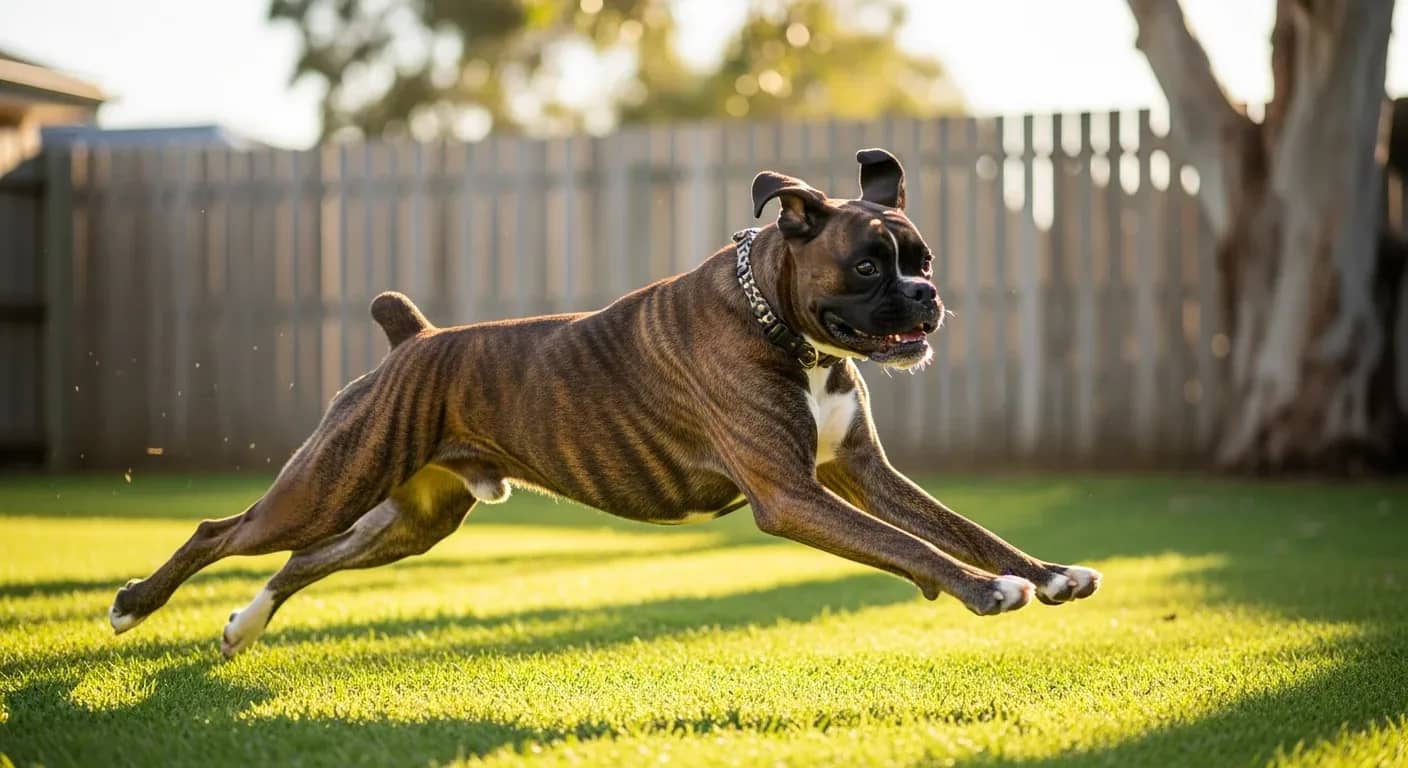

If you share your life with a Staffordshire Bull Terrier, you already know that Staffies feel everything at full volume. Joy, frustration, loneliness, excitement. They're emotionally wired dogs, deeply attached to the people they love, and that attachment can flip into anxiety faster than most breeds. If your Staffy paces, whines, destroys things when you leave, or struggles to settle in new situations, you're not dealing with a badly behaved dog. You're dealing with a dog who cares too much, and who needs a bit of extra support to find their calm.
Calming supplements have become one of the most practical tools Australian Staffy owners reach for. Not as a magic fix, but as part of a daily routine that genuinely helps. This guide covers what the science says, which ingredients are worth your attention, and how to choose a supplement that actually works for this particular breed.
Why Staffordshire Bull Terriers Are Prone to Anxiety
Staffies were originally bred for dog fighting in 19th-century England, a brutal history they've long since left behind. What that breeding left them with, though, is a dog of extreme emotional intensity. They're courageous, tenacious, and fiercely loyal, which is exactly why they became such beloved family companions. But those same traits mean they form deep bonds, and deep bonds come with separation distress.
The breed is sometimes called the "nanny dog" for its devotion to children and families. That devotion is genuine, and it means Staffies genuinely suffer when they're left alone, under-stimulated, or dealing with big changes in their environment. Research from the Frontiers in Veterinary Science journal confirms that dogs with strong human bonds show significantly higher physiological stress markers when separated from their owners than dogs with weaker attachments.
Add to that the Staffy's physical sensitivity. They're lean-bodied dogs with short coats and relatively little insulation from the cold, and they tend to be reactive to environmental changes, loud noises, and unfamiliar experiences. This isn't a breed that shrugs things off. If you want to understand the full picture of what makes Staffies tick, the guide to Staffordshire Bull Terrier behaviour and common traits covers it in detail.
Signs Your Staffy Needs Calming Support
Staffy anxiety doesn't always look like shaking or hiding. In a breed this physically confident and tenacious, anxiety often presents as big behaviour: barking, lunging, restlessness, and destruction. Here are the signs worth paying attention to.
Separation-related behaviour is the most common. Your Staffy might bark or howl after you leave, dig at doors or windows, or destroy furniture. Some dogs show more subtle signs like excessive panting, drooling, or refusing food before you go. Our guide to what to do when your Staffy shows aggression explores how anxiety and reactive behaviour are often linked in this breed.
Situational anxiety shows up around specific triggers: thunderstorms, fireworks, vet visits, car travel, or busy environments like markets and dog parks. Your dog might pull hard on the lead, refuse to settle, or become hyper-focused on the trigger in ways that are hard to interrupt.
Chronic low-level stress is subtler and easier to miss. A dog that's always "on", that can never quite settle even at home, that snaps at other dogs or family members more than usual, may be running at a baseline stress level that's higher than it should be. This kind of chronic tension wears on dogs physically over time, affecting sleep, digestion, and immune function.
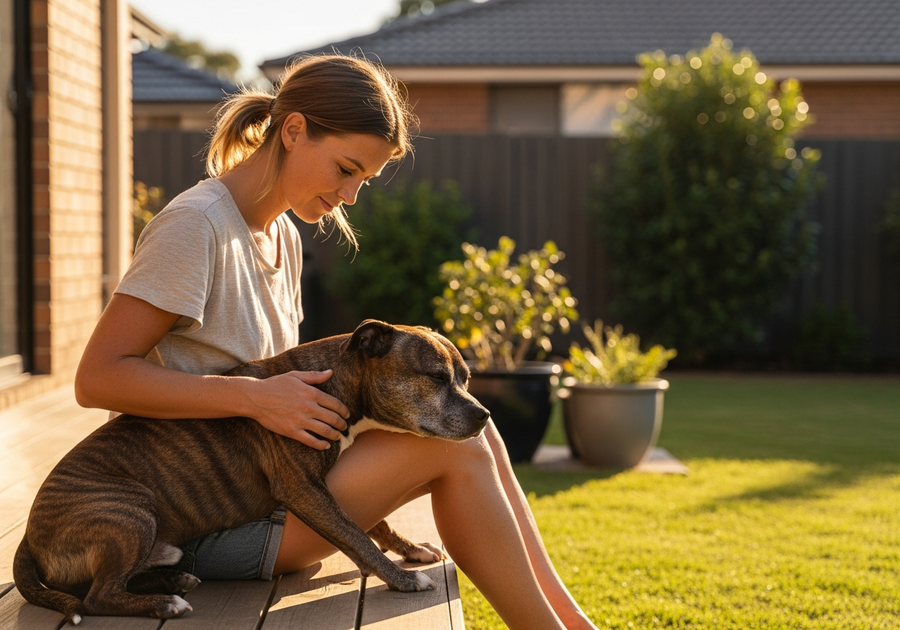
What Calming Ingredients Actually Work for Dogs
Not all calming supplements are created equal. The market is full of products that sound scientific but rely on minimal doses of underpowered ingredients. Here's what the research says about the ingredients that genuinely have evidence behind them.
L-tryptophan is an essential amino acid and the direct precursor to serotonin, the neurotransmitter responsible for mood regulation and emotional stability. Several veterinary studies have shown that dietary L-tryptophan supplementation can meaningfully reduce anxiety-related behaviours in dogs. A study published in the Journal of Nutritional Science found that L-tryptophan supplementation in dogs showed measurable reductions in stress indicators including cortisol and anxiety-linked behaviours. Doses and timing matter, which is why a daily supplement delivering consistent levels works better than sporadic use.
Magnesium plays a key role in nervous system regulation. It supports the production of GABA, an inhibitory neurotransmitter that helps the brain "switch off" the stress response. Dogs deficient in magnesium tend to show higher reactivity and poorer stress recovery. While most complete dog foods contain some magnesium, high-stress dogs burn through it faster, and supplementation can help restore balance. Research into magnesium glycinate in veterinary settings shows particularly good bioavailability compared to oxide forms.
Ashwagandha is an adaptogenic herb with a strong body of research in human medicine and a growing evidence base in animal nutrition. Adaptogens help the body respond more resiliently to stress without sedating. A 2021 study in Nutrients confirmed ashwagandha's ability to reduce cortisol levels and anxiety markers in subjects under chronic stress, and early veterinary research mirrors these findings in dogs. For a breed like the Staffy that can run chronically elevated, this adaptogenic property is particularly relevant.
Chamomile has a gentle anxiolytic (anxiety-reducing) effect that has been used medicinally for centuries. In dogs, chamomile extract supports mild relaxation without sedation. It's particularly useful for situational stress like thunderstorm sensitivity or car travel when used consistently rather than as a one-off dose.
Vitamin B1 (thiamine) supports neurological health and has been shown to reduce anxiety-linked nervous system dysregulation. B1 is water-soluble and can be depleted under stress, so ongoing supplementation helps maintain the neurological stability that anxious dogs need most.
Jerusalem Artichoke is less well-known but earns its place through its prebiotic fibre content. The gut-brain axis is increasingly understood as a major pathway for mood regulation, with research showing that gut microbiome diversity directly influences anxiety levels in dogs. Jerusalem Artichoke's inulin content feeds beneficial gut bacteria, supporting the kind of microbiome diversity associated with calmer baseline behaviour.
What to Look for in a Calming Supplement for Your Staffy
With those ingredients in mind, here's how to evaluate a supplement before buying it.
Ingredient transparency is non-negotiable. You should be able to read every ingredient on the label. Proprietary blends that list "calming complex" without individual doses are a red flag. You want to know exactly what's in each chew and how much.
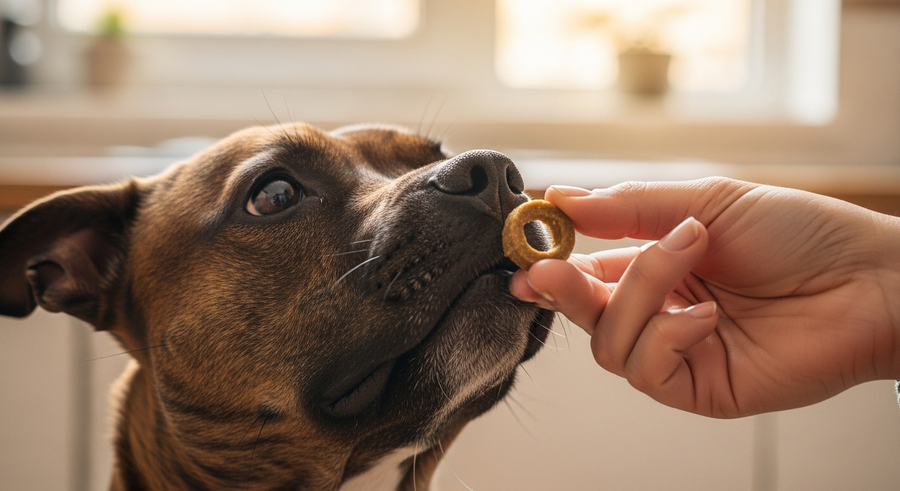
Chew format matters for Staffies specifically. This is a breed that can be food-motivated but opinionated, and a chew they actually want to eat is far more practical than a tablet you're trying to hide in their dinner. Most Staffies will take a high-quality soft chew as enthusiastically as a treat, which removes the daily struggle entirely.
Grain-free formulation is worth considering. Staffies have a higher-than-average rate of skin sensitivities and food intolerances, which often show up as itching, coat changes, and digestive upset. A supplement free from wheat and common fillers avoids adding another potential irritant to your dog's diet. Our full overview of common Staffordshire Bull Terrier health problems goes into the skin and allergy patterns common in the breed.
Australian-made and vet-reviewed formulas give you the confidence that the product meets the standards relevant to Australian dogs and owners. Local manufacturing means fresher ingredients, shorter supply chains, and product that was developed with our climate and lifestyle in mind.
Hero's Calming Daily Chews are formulated with all six ingredients covered above, Magnesium, L-tryptophan, Vitamin B1, Jerusalem Artichoke, Ashwagandha, and Chamomile, in a grain-free soft chew that most Staffies treat like a reward. The formula is vet-reviewed and made in Australia. One chew a day, given consistently, is how most owners find the best results. You can find them at Hero's calming supplement page.
How to Give Calming Supplements and What to Expect
The key word with calming supplements is consistent. Unlike pharmaceutical interventions that can produce rapid results, natural calming supplements work by gradually shifting your dog's neurological baseline. Most owners see noticeable changes in their Staffy within four to six weeks of daily use. Some see improvement sooner. Very few see meaningful change from sporadic dosing.
Give the supplement at the same time each day. Building it into your morning routine, perhaps alongside breakfast, is the approach that works best for most owners because it removes the decision-making and makes it a natural part of the day for the dog. Staffies are creatures of routine and respond well to consistent structure.
In the first few weeks, you may notice subtle changes before the big behavioural shifts arrive. Your dog might settle more quickly after exercise, show less vigilance around the front door when you leave, or sleep more deeply. These early signals are worth tracking, because they confirm the supplement is working before the more obvious behavioural improvements emerge.
Calming supplements work best alongside good management. For a breed like the Staffy, regular physical exercise, mental stimulation, and a consistent daily schedule all support calmer baseline behaviour. Supplements aren't a substitute for these foundations, but they make the foundations more effective.
When to Talk to Your Vet
Natural calming supplements are appropriate for mild to moderate ongoing anxiety, for general reactivity management, and for situational stress support like travel or fireworks season. They're not appropriate as the only intervention for severe anxiety disorders.
If your Staffy is injuring themselves trying to escape confinement, has stopped eating consistently, is showing aggression that's escalating, or hasn't responded to natural approaches after six weeks of consistent use, talk to your vet. Veterinary behaviourists can assess whether pharmaceutical support is warranted alongside lifestyle changes and supplements. In Australia, several options are available that can be used short-term to help a dog recover neurological stability before tapering back to natural support.
It's also worth noting that calming supplements interact well with most other nutritional approaches. Many Staffy owners who support their dog's gut health with a probiotic find the combination particularly effective, since gut microbiome health directly influences mood regulation. The guide to probiotics for Staffordshire Bull Terriers in Australia covers this connection in more detail.
Not sure whether your Staffy needs calming support, gut support, or both? The Hero Health Assessment takes two minutes and gives you a personalised supplement plan based on your dog's age, weight, and specific health profile.
Start the Free AssessmentThe Bottom Line
Staffies are not difficult dogs. They're emotionally intelligent, deeply bonded, and built to work alongside people. When anxiety shows up in this breed, it's usually because that emotional intelligence has nowhere healthy to go. A daily calming supplement that includes L-tryptophan, Magnesium, Ashwagandha, Chamomile, Vitamin B1, and Jerusalem Artichoke addresses the neurological and gut-brain pathways that anxiety travels through, without sedating or dulling a dog whose personality is half the reason you love them.
Start consistently. Give it six weeks. And if you want a starting point tailored to your specific dog, the Hero Health Assessment will give you a personalised recommendation in under two minutes.