

Labradoodles are brilliant dogs. That's part of what makes them such good companions. But brilliant, sensitive, high-energy dogs sometimes carry anxiety the way other breeds carry fur, and Labradoodle owners often find themselves trying to figure out why their dog is panting, barking, or spinning in circles when nothing obvious has triggered it.
Anxiety in Labradoodles is common. Both parent breeds, the Labrador Retriever and the Poodle, are intelligent, people-focused dogs, and that combination tends to produce dogs who bond deeply with their owners and notice everything. The flip side of that emotional sensitivity is that Labradoodles can struggle when routines break down, when they're left alone, or when the household energy shifts.
Calming supplements are one practical tool for managing low-to-moderate anxiety in Labradoodles. They're not a substitute for training or addressing the root cause of stress, but for dogs who need a bit of daily support, the right formula can take the edge off. Here's what to know before you buy.
Why Labradoodles Are Prone to Anxiety
Labradoodles inherit a lot from both sides of their genetics. Labradors were bred to work closely with humans and read social cues. Standard and Miniature Poodles are among the most cognitively capable dog breeds in the world. That intelligence is a gift, but it also means Labradoodles are acutely aware of changes in their environment, their owner's mood, and their daily schedule.
The most common anxiety triggers in Labradoodles include separation, loud noises (particularly thunderstorms and fireworks), changes in routine, new environments, and unfamiliar people or other dogs. Labradoodles bred as assistance or therapy dogs often handle these triggers well, but pet Labradoodles, especially those who don't get enough mental stimulation or exercise, can develop anxiety habits that compound over time.
Signs worth paying attention to: excessive barking when left alone, destructive behaviour around doorways or windows, pacing, panting without physical cause, refusing food when you leave the house, or a dog who cannot settle even after adequate exercise. If these patterns sound familiar, it's worth talking to your vet about behavioural support alongside any supplement you're considering. You can also read our full guide to common Labradoodle health problems for a broader picture of what this breed tends to deal with.
What to Look for in a Calming Supplement
The supplement market is crowded and the quality varies enormously. Most pet owners find that understanding a handful of key ingredients helps cut through the noise.
Magnesium is the standby. It plays a role in nervous system regulation and many dogs, like many humans, don't get enough through diet alone. Low magnesium is associated with heightened stress responses and poor sleep quality. Supplementing it tends to have a calming, steadying effect over time rather than a sedating effect in the moment.
L-tryptophan is an amino acid that the body uses to produce serotonin, the neurotransmitter associated with mood regulation and emotional wellbeing. It doesn't produce an instant effect. L-tryptophan works as a daily support compound, and most dogs need two to four weeks of consistent use before owners notice a meaningful difference in baseline anxiety.
Ashwagandha is an adaptogenic herb with a reasonable body of evidence behind it in human medicine and growing interest in veterinary applications. Adaptogens help the body modulate its stress response, rather than simply suppressing it. For dogs who tend to over-react to minor triggers, ashwagandha may help level out the peaks.
Chamomile is the gentlest ingredient on this list. It has mild calming properties and works well as a complementary ingredient rather than a standalone solution. In supplement form, it contributes to an overall calming effect without being strong enough to dull a dog's personality.
Vitamin B1 (Thiamine) is involved in nerve function and is commonly depleted in stressed or anxious dogs. Thiamine deficiency can exacerbate anxiety symptoms, so ensuring adequate levels through supplementation makes sense as part of a broader calming formula.
Jerusalem Artichoke is a prebiotic ingredient. The gut-brain connection in dogs is increasingly well understood, and supporting healthy gut bacteria through prebiotic fibre is emerging as a useful indirect approach to reducing anxiety. It is not a direct calming agent but it supports the underlying biology that anxiety medications and supplements work with.

How Calming Supplements Fit Into a Broader Strategy
Supplements work best as part of a routine, not as a crisis response. If your Labradoodle is genuinely anxious, the most effective approach combines daily supplementation, consistent training, adequate physical and mental exercise, and sometimes professional behavioural support.
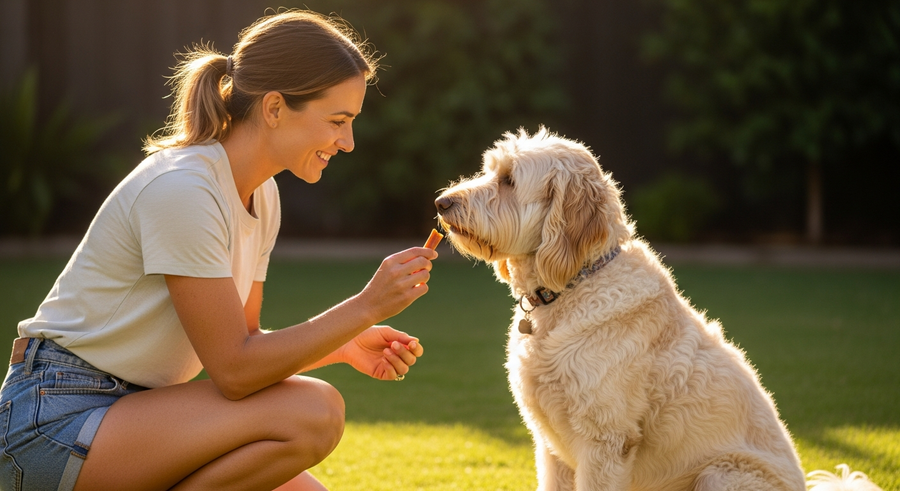
A daily calming chew is easy to work into your dog's morning or evening routine, and most Labradoodles take them without fuss because they're designed to taste like a treat. The key is consistency. Skipping doses regularly undermines the benefit of most of the active ingredients, particularly L-tryptophan and magnesium, which accumulate over time rather than working acutely.
Exercise matters a lot for Labradoodles specifically. These are active dogs who need 60 to 90 minutes of physical activity per day, plus regular mental stimulation. A Labradoodle who is not getting enough of both will tend to express surplus energy as anxiety, and no supplement addresses that directly. Supplements reduce the biological floor of anxiety. Exercise, training, and routine reduce the triggers.
If your Labradoodle's anxiety is severe or is getting worse despite lifestyle changes and supplementation, your vet is the right next step. Anxiety disorders in dogs are among the most treatable behavioural conditions when addressed early, and most vets will recommend a combination of behavioural modification and daily supplementation as a first approach before moving to prescription options.
Not sure whether calming support is right for your Labradoodle, or whether joint health or gut health should come first? The Hero Health Assessment takes 2 minutes and gives you a personalised supplement plan based on your dog's age, weight, and lifestyle.
Start the Free AssessmentHero Calming Chews: What's in Them
Hero's Calming Daily Chews are made in Australia and vet reviewed. The formula includes magnesium, L-tryptophan, Vitamin B1, Jerusalem Artichoke, ashwagandha, and chamomile, which covers the main ingredient categories discussed above. They're designed as a daily routine supplement rather than a situational product, which aligns with how the active ingredients actually work.
Most Labradoodles take to them easily. The chew format means they're treated as part of the feeding routine rather than a battle. At $59.95 per pack (around $50.96 with a subscription), they're priced in line with other quality Australian calming supplements.
Worth noting: the formula is grain-free, which matters for Labradoodles with food sensitivities. Some Labradoodles, particularly those with Poodle-dominant genetics, have a higher rate of food allergies than average, so a clean ingredient list is worth checking. You can see the full details at the Hero Calming Chews product page.
Setting Expectations: What Calming Supplements Can and Cannot Do
Be honest with yourself about what you're hoping for. Calming supplements support healthy nervous system function and reduce baseline anxiety in dogs who benefit from that kind of daily support. They won't knock a dog out or suppress their personality. They won't stop a Labradoodle from reacting to a thunderstorm if that dog has a strong noise phobia. They won't address separation anxiety that's rooted in a deep attachment pattern without accompanying behavioural work.
What they can do is reduce the frequency and intensity of anxiety responses in dogs with mild to moderate generalised anxiety. They can help a Labradoodle settle more easily after excitement. They can reduce panting and restlessness during lower-level stressors. Over the first month of consistent use, many owners notice their dog is simply more regulated day-to-day.
If you're also concerned about your Labradoodle's joint health, which is worth monitoring in larger Labradoodles as they age, our guide to the best joint supplements for Labradoodles in Australia covers that ground. For a broader picture of this breed's lifespan and what health challenges to expect at different life stages, the Labradoodle lifespan guide is worth reading.
A 2022 review published in Animals (MDPI) looked at the evidence base for nutraceutical interventions in anxious dogs and found meaningful support for several supplement categories, while also noting that response varies between individual dogs. Not every dog responds the same way, and patience through the initial weeks matters more than most owners expect.
Research from the National Center for Biotechnology Information also supports magnesium and tryptophan supplementation as part of multi-modal anxiety management in companion animals, with the best outcomes seen when supplements are used consistently alongside environmental and behavioural interventions.
The Bottom Line
Labradoodles are emotionally intelligent dogs and that is a feature, not a bug. It also means they can be more sensitive to stress than more independent breeds. A quality calming supplement containing magnesium, L-tryptophan, ashwagandha, and chamomile gives your dog's nervous system daily support, and most Labradoodles respond well with consistent use over four to six weeks.
Every Labradoodle is different. If you want a personalised recommendation based on your specific dog's age, weight, and lifestyle, the Hero Health Assessment will point you in the right direction in under two minutes.