

If you have ever watched your Labradoodle pause at the back steps before bouncing up, or take a bit longer to settle after a beach run, you have probably wondered when joint care should start. Labradoodles inherit a lot of their health story from the Labrador side of the family, and that includes a real risk of hip and elbow problems. The good news is that small daily habits, started early, do most of the heavy lifting.
This guide walks through what to actually look for in a joint supplement for an Australian Labradoodle, which ingredients have the best support behind them, and how to fold it into a daily routine your dog will treat like a treat.
Why Labradoodles Need Joint Support Earlier Than You Think
Labradoodles are crosses of a Labrador Retriever and a Standard or Miniature Poodle. Both parent breeds are listed in the top breeds affected by canine hip dysplasia, and orthopaedic vets describe Labradoodles as moderately to highly susceptible depending on size and lineage. Elbow dysplasia and patellar luxation also show up more often than in many smaller crossbreeds.
According to the Cornell University College of Veterinary Medicine, around 1 in 5 dogs over the age of 1 shows signs of osteoarthritis, with risk climbing sharply in larger breeds and active working-line crosses. For Labradoodles in Australia, who often live a high-energy beach and bushland lifestyle, that means joint stress accumulates fast.
The early signs are usually subtle: a stiff first walk of the morning, hesitation jumping into the boot of the car, lying down a fraction more carefully. If those start appearing, talk to your vet about a hip and elbow assessment. Most Australian vets recommend a baseline orthopaedic check around 6 months for medium and standard Labradoodles. For a deeper look at breed-specific risks, our guide to common Labradoodle health problems every owner should know covers the full picture.
What Actually Works in a Joint Supplement
Joint supplements are not a one-size category, and the research behind each ingredient varies. Here is the honest breakdown for Australian dog owners.
The well-researched ingredients
Glucosamine and chondroitin are the most studied combination. They are the building blocks of cartilage, and a body of clinical research, summarised by dvm360, suggests modest improvements in mobility scores after 8 to 12 weeks of daily use. Many traditional Australian joint chews lead with these.
Green-lipped mussel is rich in omega-3s and has anti-inflammatory effects. Omega-3 fatty acids from fish oil have the strongest evidence for reducing joint inflammation in dogs.
A different and growing category uses a collagen-first formula: MSM, Collagen Peptides, Turmeric, and Vitamin C (Ascorbic Acid). Collagen is the actual structural protein of cartilage, and Vitamin C is required to synthesise new collagen in the body. Turmeric provides natural anti-inflammatory support, and MSM is a sulphur compound that supports connective tissue. Four ingredients, each doing a specific job in the joint.
What this means for choosing
If your vet has specifically recommended a traditional cartilage-support formula for an existing diagnosis, look for an Australian-made product that includes those building blocks. If you are starting daily support proactively for a younger or middle-aged Labradoodle, a collagen-led formula is a strong fit because collagen and Vitamin C work together at the cartilage-building stage rather than after damage has set in.
The deeper science of how these ingredients interact is covered in our dog joint health hub, and you can compare the leading Australian options in our best dog joint supplements Australia 2026 roundup.
How to Choose a Joint Supplement for Your Labradoodle
A few practical filters cut through the marketing noise quickly.
Australian-made and clearly labelled
Imported supplements often skip ingredient quantities on the label. Australian-made brands are required to list amounts per chew, which lets you and your vet check the dose. Look for the country of manufacture, not just the country of the brand.
The right format for your dog
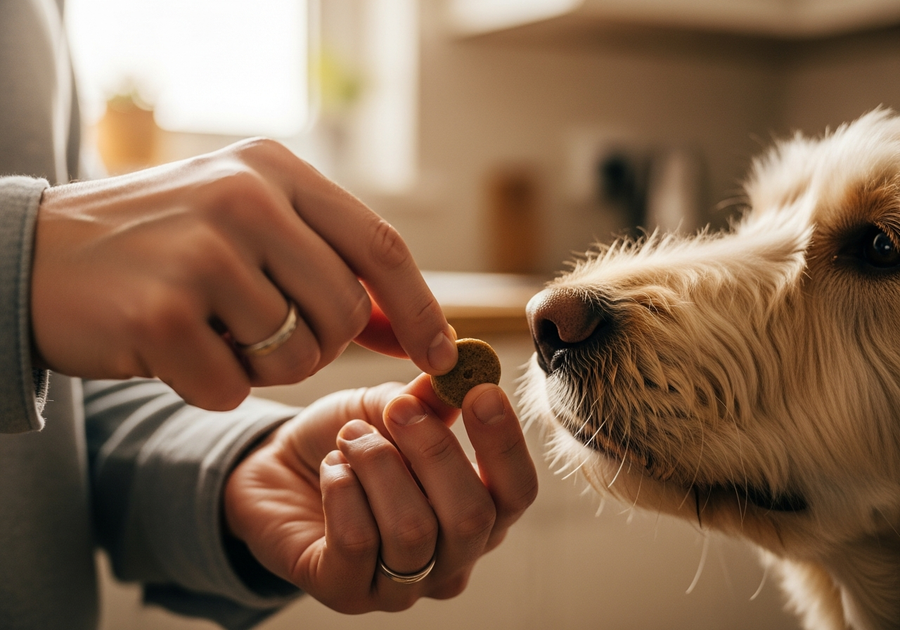
Labradoodles are food-motivated, so soft chews tend to be easier than capsules or powders mixed into food. The chew format also gives consistent daily dosing, which matters more than peak potency. A daily soft chew that your dog actually eats beats a high-potency capsule sitting in the cupboard.
Vet-reviewed and clearly dosed
Any reputable Australian joint supplement will state that it is vet reviewed, list ingredients per chew, and give a weight-based feeding guide. Hero's Joint Daily Chews follow this pattern: vet reviewed, made in Australia, 1 to 2 chews per day depending on weight, with the 4-active formula above.
What to skip
Avoid joint products that promise to "cure arthritis" or "replace medication". No supplement does either. Also be wary of formulas that pack a dozen ingredients at low doses. Four to six well-dosed actives generally outperform a long list at trace levels.
Early Signs Your Labradoodle Needs Joint Support
Labradoodles are stoic dogs. They will keep showing up for the morning walk long after their joints start to ache, which is part of what makes early detection tricky. The signs to watch for are subtle and easy to put down to age or weather.
Watch for a slower start in the morning, where the first 5 minutes of movement looks stiff before they warm up. Notice if your dog is now walking around the lounge instead of jumping on it, or pausing before getting into the boot of the car. Bunny-hopping during a run, where both back legs move together, can suggest hip discomfort. Any reluctance to put weight on a single leg deserves a vet visit, not a supplement.
For older Labradoodles, watch for the slow loss of muscle around the hips and a reluctance to do their favourite things. A dog that has stopped asking for the beach is telling you something. Our guide to Labradoodle lifespan and senior care covers the full picture of what changes through the years.
Dosing and Timing for Labradoodles
Most Australian Labradoodles fall into the medium to large size range, between 15 and 30kg. Soft chew supplements are usually dosed by weight: 1 chew daily for under 15kg, 2 chews for 15 to 30kg, and 3 for 30kg or above. Always check the pack and your vet's advice for specifics.
Start with the chew at breakfast so it becomes part of the morning routine. Daily consistency matters far more than time of day. Most dogs show small changes in willingness to move, ease getting up, and recovery after exercise within 6 to 8 weeks of daily use.
If your Labradoodle is on prescription anti-inflammatories or joint medication, talk to your vet before adding a supplement. Most are compatible, but it is a 30-second phone call that protects your dog.

Australian Lifestyle Considerations
Australian Labradoodles tend to live big. Beach trips, off-lead bushwalks in the Dandenongs or Royal National Park, and long days in the backyard all add up to high cumulative joint load over a lifetime. Heat is a quiet factor too. Dogs that overheat tend to lie down on hard surfaces, which puts pressure on the same hip and elbow joints they already work hard during the day.
A few Australian-specific habits make a real difference. Keep walks to early morning or after dusk in summer. Use a raised bed indoors so your dog isn't sleeping on tiles or polished floorboards. After beach runs, give a gentle warm-down on grass before getting in the car. And in winter, especially in Melbourne and Hobart, expect stiffness to ramp up: this is when daily supplement consistency really earns its place.
Daily Habits That Multiply the Benefit
A supplement does its best work alongside the rest of the routine. The factors with the biggest evidence behind them are weight, low-impact exercise, and consistent daily movement.
Keeping your Labradoodle within a healthy weight range reduces hip and elbow stress more than any supplement. Even a 10 percent reduction in body weight in an overweight dog can noticeably improve mobility scores. Swimming, sand walks, and gentle off-lead time on grass are kinder on joints than long pavement runs. For a full breakdown of nutrition that supports joint and weight goals, see our Labradoodle nutrition guide.
If your dog is older, our Labradoodle lifespan guide covers how mobility expectations should shift through the senior years.
Not sure where to start with your Labradoodle's joint care? The Hero Health Assessment takes 2 minutes and gives you a personalised supplement plan based on your dog's age, weight, and activity level.
The Bottom Line
Labradoodles do well on a daily joint supplement started in middle age, or earlier if your vet flags any hip or elbow concerns. Look for an Australian-made, vet reviewed formula with clearly listed actives in a chew your dog will actually eat. Weight management and gentle exercise multiply the benefit.
Every Labradoodle is different. If you want to know exactly what your dog needs, the Hero Health Assessment will give you a personalised recommendation in under two minutes, and a vet review on every order.