

Labradors are easy to love and, at times, a nightmare to own a stomach for. If your Lab has ever swallowed a pair of socks, inhaled a bowl of food in thirty seconds, or grazed the backyard like a small sheep, you already know what this breed is like. That appetite is hardwired into their genetics, and it has real consequences for their gut health.
Why Labradors Are Particularly Prone to Gut Issues
In 2016, researchers at Cambridge University identified a mutation in the POMC gene affecting a significant proportion of Labrador Retrievers. This gene governs hunger and satiety signals. Dogs with the mutation feel less full and are driven to seek food constantly. It explains why Labs are such enthusiastic training partners and also why they frequently raid bins, eat things they should not, and scavenge on walks. Every piece of inappropriate food they consume puts the gut under stress.
Beyond dietary opportunism, Labradors, particularly yellow Labs, show higher rates of food allergies and sensitivities than many other breeds. Common triggers include beef, dairy, and wheat. When the gut lining is repeatedly irritated by allergens or unsuitable material, the balance of beneficial bacteria shifts and digestive symptoms follow: loose stools, gas, intermittent vomiting after scavenging, and a coat that loses its shine.
Understanding common Labrador health problems gives you the fuller picture of what to watch for at each life stage. Gut health is one of the most consistent concerns for this breed, and it is one of the most manageable with the right daily routine.
What Probiotics Actually Do for Your Labrador's Digestive System
Probiotics are live microorganisms that, taken consistently, support the balance of the gut microbiome. The gut is not just a digestion tube. It houses trillions of microorganisms that influence how your dog absorbs nutrients, regulates immune responses, and manages stress. When that ecosystem gets disrupted by illness, antibiotics, or eating something they definitely should not have, the effects show up as loose stools, low energy, skin flare-ups, and coat changes.
Most probiotic products contain bacterial strains from the Lactobacillus or Bifidobacterium families. These can be useful, but they are vulnerable to antibiotics because antibiotics target bacteria. Hero Probiotic Chews use a different approach. The active ingredient is Saccharomyces boulardii, a yeast rather than a bacterium. Because S. boulardii is a yeast, it survives antibiotic treatment. For Labradors who tend to swallow things they should not, gut infections and the antibiotics that follow are an occupational hazard. A probiotic that keeps working through antibiotic treatment is a practical advantage for this breed.
A 2020 review published in Frontiers in Veterinary Science found that S. boulardii reduced the duration and severity of acute diarrhoea in dogs, with particular benefit in cases involving antibiotics and dietary indiscretion. Both are common Labrador scenarios. Our complete guide to dog probiotics in Australia covers how different probiotic types compare if you want to read further.
What to Look For in a Probiotic for Your Labrador
The Australian market has dozens of probiotic options at various price points. Here is what actually matters when you are choosing one for your Lab.
CFU count at a therapeutic level
CFU stands for Colony Forming Units, the measure of live organisms per dose. For gut support to be meaningful, the count needs to be high enough to genuinely influence the gut environment. Hero Probiotic Chews deliver 10 billion CFU of S. boulardii per chew. Products delivering under 1 billion CFU are unlikely to produce the gut changes that make a visible difference in stool quality or digestive stability.
Antibiotic compatibility
If your Labrador ends up on antibiotics, most bacterial probiotics become largely ineffective during treatment because antibiotics target bacteria. A yeast-based formula like S. boulardii keeps working. This is one of the most clinically relevant differences between probiotic types for this breed. Our article on probiotics for dogs after antibiotics explains when to start supplementation and how long to continue.
Grain-free and hypoallergenic formula
Given Labradors' tendency toward food sensitivities, the supplement itself should not introduce new irritants. Look for a product that is wheat-free, grain-free, and free from common allergens. Hero Probiotic Chews are grain-free and hypoallergenic, making them suitable for even the more reactive Labs. An Australian-made, vet-reviewed formula with transparent ingredient labelling offers the most accountability for a daily supplement you are giving for the long term.
Soft chew format
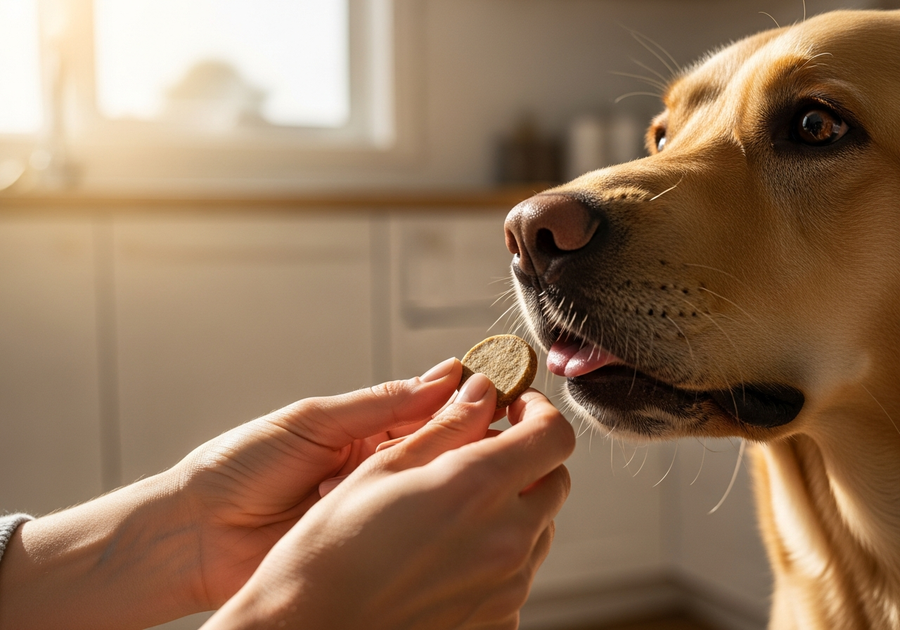
For a Labrador, format is almost a non-issue because Labs will consume anything you hand them. Soft chews are consistently more bioavailable than pressed tablets, and most Labs eat their probiotic chew before you have put the packet away. Knowing the signs your dog needs a probiotic helps you decide when to start and what improvements to watch for once you do.
How to Give Probiotics to Your Labrador
The case for daily supplementation is strong for this breed. Rather than waiting for a stomach upset to act, daily probiotics build a more resilient gut microbiome over time. A well-supported gut is less reactive to the dietary adventures that are, for many Labs, simply part of life.
Dosing is weight-based. For an adult Labrador in the 25-35kg range, one soft chew daily provides the appropriate CFU load. Check the product label for your dog's exact weight range. For senior Labradors over eight years, gut health becomes even more important. The diversity of beneficial gut bacteria decreases with age, and daily supplementation helps offset that decline and keeps digestion stable through the senior years.
Give the chew at the same time each day. The gut microbiome benefits from consistency more than from timing. Many owners pair it with breakfast because that is already a fixed part of the routine. After antibiotics, illness, or an episode of dietary mischief, daily use for at least two to four weeks is recommended to see meaningful restoration of gut balance. Our guide to probiotics for dogs with diarrhoea covers what to do during acute episodes specifically.
It is worth noting that the gut microbiome is not a static system. It shifts in response to diet, stress, exercise changes, and seasonal fluctuations. Labradors that spend their winters predominantly indoors and their summers active outdoors often show gut changes simply from the lifestyle shift. A consistently administered daily probiotic acts as a stabilising baseline through those fluctuations, rather than leaving the gut microbiome to swing with every environmental change.
For Labrador owners who feed a raw diet or rotate between protein sources, probiotics are particularly useful. Protein transitions are a common trigger for transient gut imbalance. When the microbiome is well-supported before the switch, the transition tends to go more smoothly with fewer days of loose stools in the middle. Pair the transition with a consistent probiotic and most Labs handle the change without incident.
Not sure whether your Labrador needs a probiotic, a joint supplement, or something else entirely? The Hero Health Assessment takes two minutes and gives you a personalised recommendation based on your dog's specific age, weight, and health profile.
Start the Free AssessmentSigns Your Labrador's Gut Needs Support
Some Labradors show obvious gut problems. Others give more subtle signals. Here is what to watch for.
The clearest signal is inconsistent stool quality. A healthy Labrador produces firm, well-formed stools. If yours regularly delivers loose or soft output without a clear dietary cause, gut flora imbalance is likely contributing. Frequent gas is another signal. Labradors can produce gas that is both silent and extremely effective at clearing a room.
Skin and coat changes are less obvious but important. The gut and skin are connected through immune function. When the gut microbiome is out of balance, inflammatory responses can show up as itching, hot spots, or a coat that has lost its usual density and shine. Many Labrador owners who start daily probiotics for digestive reasons notice coat improvements within a few weeks, which reflects the broader benefit of restoring gut health.
Excessive grass-eating is a self-regulating behaviour. Dogs eat grass when their stomach feels uncomfortable. If your Lab is doing regular circuits of the backyard while grazing, the gut is giving you a signal worth listening to.
After dietary changes, illness, travel stress, or antibiotic treatment, most Labradors benefit from a deliberate probiotic reset. The gut does not automatically re-balance without support, and the faster microbial diversity is restored, the less time your dog spends feeling unsettled. Read our guide to probiotics for senior dogs for how needs shift as your Labrador gets older.
The Bottom Line
Labradors are among the dog breeds most likely to benefit from daily probiotic supplementation. Their genetic drive to eat anything, higher susceptibility to food sensitivities, and the regular gut disruptions that come from an enthusiastic appetite all create conditions where consistent gut support makes a real difference.
Starting a daily probiotic routine before problems appear, rather than waiting for a stomach upset, keeps your Labrador's digestion stable and their energy consistent across the years. Your Labrador shows up for you every day. A daily probiotic chew is a small, straightforward way to return the favour.
Every Labrador is a little different. If you want to know exactly what your dog needs based on their specific age, weight, and lifestyle, the Hero Health Assessment will give you a personalised recommendation in under two minutes.