

Poodles notice everything. They read the room, pick up on schedules, and track your movements with the kind of focus that makes them extraordinary companions. That same intelligence, the thing that makes them so easy to train and so deeply in tune with their families, is also what makes them prone to anxiety when things feel uncertain or off.
Separation anxiety, noise sensitivity, changes in routine. These are some of the most common poodle health concerns Australian owners bring to their vets. Whether you have a Standard, Miniature, or Toy Poodle, the sensitivity is consistent across all three sizes. The nervous system of a highly intelligent breed needs support, and for many Poodle owners, calming supplements are a meaningful part of that.
This guide explains which ingredients actually help, what to look for in a quality supplement, and how to build a daily routine that makes a difference.
Why Poodles Are More Likely to Experience Anxiety
Poodles were originally bred as working water retrievers, spending long days in close partnership with hunters. That selection for attentiveness, responsiveness, and social bonding has carried through centuries of breeding. Today's Poodles are among the most intelligent dog breeds in the world, reliably ranked at or near the top of canine intelligence assessments.
High intelligence is wonderful until it turns inward. A Poodle left alone with nothing to process starts looking for problems to solve. A schedule change that a lower-energy breed might not notice is something a Poodle files away and questions. New sounds, visitors, or routines that feel unfamiliar register more acutely for a breed hardwired to observe and respond.
According to VCA Animal Hospitals, separation anxiety is one of the most frequently diagnosed behavioural problems in dogs, with breeds that have strong social bonds showing higher rates. Poodles form deep attachments to their families, and that attachment becomes a vulnerability when the people they rely on are not around.
Toy and Miniature Poodles are sometimes more reactive than Standards, partly because their smaller size means more of the world feels disproportionately large and potentially threatening. But anxiety is not size-dependent. Standards can be just as sensitive, particularly if they have not had consistent socialisation during puppyhood.
Signs Your Poodle May Need Calming Support
Anxiety in Poodles often shows up in the details. Some owners notice obvious signs straight away. Others only realise in retrospect, when a supplement or training change made the difference and they saw how tightly wound their dog had been.
- Pacing or circling before departures or during predictable triggers like putting on shoes or picking up keys
- Whining or barking when left alone, sometimes escalating to howling that neighbours notice first
- Destructive behaviour focused on exits: door frames, window ledges, skirting boards near the front door
- Excessive licking or grooming, particularly of the paws, which can become a self-soothing compulsion
- Digestive upset around stressful events. Poodles who vomit before vet visits or car trips are often showing anxiety, not motion sickness
- Shaking or trembling during thunderstorms, fireworks, or other loud environmental events
- Clinginess that feels like escalation, following you room to room and becoming distressed if doors are closed between you
Not every Poodle showing these signs has a clinical anxiety disorder. Many are simply reactive, their baseline stress response running a little higher than it needs to. That is exactly where daily calming supplements can help, not as a fix for severe behavioural problems, but as support for the nervous system to find a steadier baseline.

Ingredients That Support a Calmer Nervous System
Not all calming supplements are equal. The market is full of products that lean heavily on low-dose herbs and marketing language without meaningful concentrations of the ingredients that actually move the needle. Here is what to look for when reading a label.
Magnesium
Magnesium plays a role in regulating the nervous system, including how the body responds to stress. Deficiency in magnesium has been linked to increased anxiety and heightened reactivity in both humans and animals. For Poodles who seem wound up at a baseline, magnesium is one of the more well-supported additions to a calming formula.
L-Tryptophan
L-tryptophan is an amino acid that the body converts into serotonin, the neurotransmitter most closely associated with mood regulation and calm. Dogs cannot produce it themselves; it has to come from diet or supplementation. A supplement that includes L-tryptophan is supporting the body's own chemistry rather than forcing an immediate external effect.
Ashwagandha
Ashwagandha is an adaptogenic herb with a growing body of research around cortisol management and stress response. In dog supplements, it is typically included at doses that support the adrenal response over time rather than providing an immediate effect. It is a daily-routine ingredient, not a situational one.
Chamomile
Chamomile has a long history of use for mild anxiety and digestive discomfort. For dogs, it is particularly useful because anxiety and gut upset often travel together. A Poodle who gets an upset stomach during stressful events may benefit from chamomile addressing both sides of that response.
Vitamin B1 (Thiamine)
Thiamine is involved in nerve function and plays a role in the nervous system's ability to handle stress. Dogs who are chronically anxious may have higher thiamine demands than those who are not. Including it in a calming formula addresses what the nervous system needs to function well under pressure.
Jerusalem Artichoke
Jerusalem artichoke is included in some calming formulas as a prebiotic. The gut-brain connection in dogs is real: gut health influences neurotransmitter production, and supporting the gut microbiome has measurable downstream effects on mood and reactivity.
A good calming supplement includes several of these ingredients in combination. The interaction between magnesium, L-tryptophan, and adaptogens like ashwagandha is more useful than any single ingredient in isolation.
Building a Daily Calming Routine for Your Poodle
The key word is daily. Calming supplements work by supporting the nervous system over time, not by switching off anxiety when it appears. Many Poodle owners give supplements situationally, before a thunderstorm or a car trip, and then wonder why they do not see much effect. By the time the stressor arrives, it is too late for the supplement to have built up in the system.
A daily routine changes the baseline. When the nervous system is consistently supported with magnesium, L-tryptophan, and adaptogens, the reactive threshold shifts. Triggers that previously sent your Poodle into a spiral start to register at a lower intensity. The dog is not dulled or suppressed. They are simply operating from a steadier nervous system.
For Poodles, routine itself is calming. A breed that reads schedules and patterns responds well to a supplement given at the same time each day, ideally as part of a ritual they come to recognise and anticipate. Soft chew formats work especially well because most Poodles treat them as a reward rather than medication.
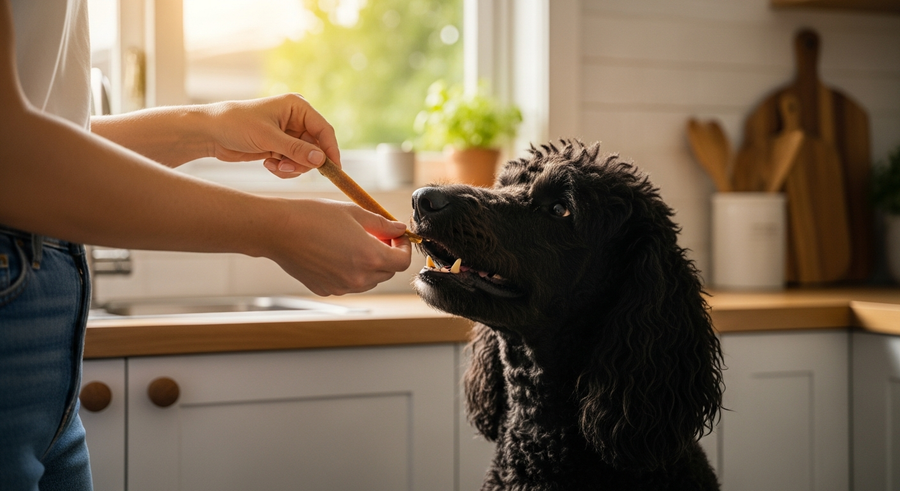
Allow at least two to four weeks before evaluating whether a supplement is helping. The effects are cumulative. If you are not seeing any change after four weeks on a consistent daily dose, that is worth discussing with your vet. For some dogs with more pronounced anxiety, supplementation works best alongside behavioural training rather than as a standalone intervention.
What to Look for in a Calming Supplement for Your Poodle
With the supplement market as crowded as it is, here are the practical things that separate a product worth trying from one that is unlikely to deliver.
Multiple active ingredients. A product built around a single herb at trace doses is unlikely to have a meaningful effect. Look for formulas that combine several mechanisms: something for the nervous system, something for the stress response, and ideally something for gut health.
Australian-made. Manufacturing standards in Australia are tightly regulated. Products made here are subject to stricter ingredient traceability and quality control than many imported alternatives. For a daily supplement that your dog takes every day, provenance matters.
Vet-reviewed formulation. Not every brand that claims vet approval has gone through a genuine formulation review. Look for brands that are transparent about their advisory relationships and make specific claims about what was reviewed.
Soft chew format for daily use. Tablets and powders tend to require workarounds to get Poodles to take them consistently. A soft chew that tastes like a treat removes that friction entirely. Daily supplementation only works if the dog actually gets it every day.
Grain-free and hypoallergenic where possible. Poodles can have sensitivities that affect overall health beyond the joint area. A supplement free from wheat, grain, and common allergens is safer for a breed that often has a reactive digestive system.
Hero's Calming Daily Chews are vet reviewed, made in Australia, and formulated with magnesium, L-tryptophan, ashwagandha, chamomile, Vitamin B1, and Jerusalem artichoke. They are grain-free, soft chews that dogs take willingly as part of a daily routine. The Hero Calming Chews ($59.95 for a pack of approximately 60 chews) come with a lifetime money-back guarantee.
If your Poodle's anxiety seems significant, talk to your vet before relying solely on supplements. For dogs with established anxiety disorders, supplements work best as part of a broader plan that may include behaviour modification, environmental management, and in some cases, medical support. Read our full guide to common Poodle health problems to understand the broader picture of what affects this breed.
Not sure whether your Poodle needs calming support, joint care, or gut health? The Hero Health Assessment takes 2 minutes and gives you a personalised supplement recommendation based on your dog's age, size, and specific needs.
Start the Free AssessmentThe Bottom Line
Poodles are sensitive, smart dogs whose intelligence makes them wonderful companions and, for the same reason, more prone to anxiety than many other breeds. Daily calming supplements containing magnesium, L-tryptophan, ashwagandha, chamomile, Vitamin B1, and Jerusalem artichoke can help support a steadier nervous system over time, but they work best as part of a consistent daily routine rather than a reactive response to triggers.
For more on your Poodle's long-term health picture, including how lifespan and ageing affects their needs, see our guide to Poodle lifespan in Australia. Every Poodle is different. If you want a personalised starting point for your dog's health routine, the Hero Health Assessment will give you a clear recommendation in under two minutes.