
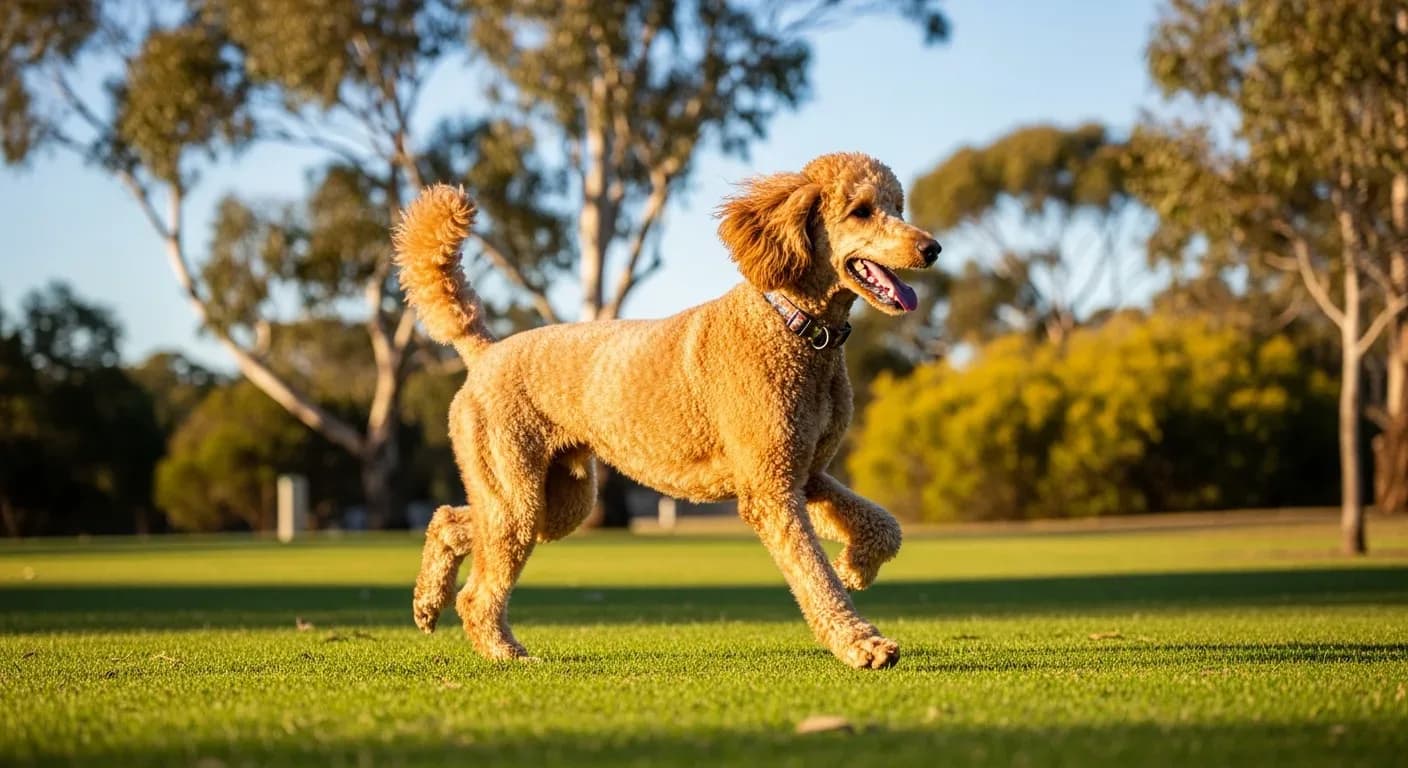
Poodles carry themselves with a kind of quiet poise. The springy gait, the elegant trot, the ease with which they pivot mid-zoomie. So when a Poodle starts to skip on a back leg, hesitate before a jump, or stand up a little stiffly after a nap, it stands out. Something is off, and most Poodle parents notice quickly.
Joint issues are one of the most common reasons Australian Poodle owners start looking at supplements. The breed (across Toy, Miniature, and Standard sizes) sits in a tricky overlap: small enough to be prone to luxating patella and Legg-Calvé-Perthes, big enough in the Standard to face hip dysplasia, and active enough across all three sizes that wear and tear shows up earlier than people expect.
This guide walks through what actually causes joint problems in Poodles, what the research says supports their joint health, and how to choose a daily joint supplement in Australia in 2026 without falling for marketing fluff.
Why Poodles Need Joint Support Earlier Than Most Owners Realise
Poodles are athletic dogs. The Standard was bred to retrieve waterfowl, the Miniature to be a tireless companion, and even the Toy keeps a working dog's drive in a tiny frame. That athleticism is wonderful, but it also means the joints take a beating across a Poodle's life. Add in some breed-specific structural risks and you have a breed that benefits from proactive joint care, ideally before symptoms appear.
Three conditions show up repeatedly in Poodle veterinary literature, and the size variant changes which one is most likely.
Luxating Patella (Most Common in Toy and Miniature Poodles)
A luxating patella is a kneecap that slips out of its groove. It causes that distinctive "skip and hop" gait Toy and Miniature Poodle owners often spot first. According to a 2019 study in the Journal of Veterinary Internal Medicine, Toy Poodles are among the breeds with the strongest genetic predisposition to patellar luxation, with affected littermates carrying a 16-fold higher risk than the general dog population. Females and neutered dogs sit at slightly higher odds again.
Mild cases (grade 1 or 2) often respond to weight management, controlled exercise, and joint support. More severe grades may need surgery, which is why early recognition matters.
Hip Dysplasia (Most Common in Standard Poodles)
Hip dysplasia is a malformation of the hip joint that causes the femur to sit poorly in the socket. Over time it leads to cartilage wear and arthritis. Data from the Orthopedic Foundation for Animals shows roughly 12% of Standard Poodles screened test positive for hip dysplasia, which sits below the all-breed average of about 15.5% but is still high enough that any responsible Standard Poodle breeder in Australia should be hip-scoring their breeding stock.
Early signs in a Standard Poodle include a "bunny hopping" run, reluctance to climb the back steps, and stiffness after lying down. If your dog shows these, book a vet visit. Reading our full guide to common Poodle health problems every owner should know will give you context on what else to watch for at the same time.
Legg-Calvé-Perthes Disease (Toy and Miniature Poodles)
This is a degeneration of the head of the femur that almost exclusively affects small breeds, including Toy and Miniature Poodles. It usually appears between 4 and 12 months of age, and it presents as a sudden hindlimb lameness that gets worse with exercise. Surgery is often needed, but post-surgical joint support and weight control make a significant difference to long-term mobility.
Age-Related Arthritis (All Sizes)
Even Poodles without a structural issue tend to develop osteoarthritis as they age, particularly Standards over 7 and Toys and Minis over 9. The good news is Poodles often live long lives. Our guide to Poodle lifespan and how long they live shows the breed regularly hits 14 to 16 years, which is exactly why daily joint support starts to matter so much in middle age.
What Actually Works: Joint Ingredients With Real Evidence

The Australian dog supplement market is crowded, and not every "joint formula" earns the name. Here is what the peer-reviewed research actually backs.
Collagen Peptides (Type II Especially)
Collagen is the structural protein in cartilage, tendons, and ligaments. Supplementing with hydrolysed collagen peptides gives the body the amino acid building blocks it needs to maintain those tissues. A 2024 randomised, placebo-controlled study published in PLOS One found that dogs supplemented with undenatured type II collagen showed measurable improvement in mobility and reduction in pain markers compared to placebo, with effects emerging within weeks rather than months.
Collagen Peptides sit at the centre of Hero's joint formula for exactly this reason. It is the structural foundation, not a buzzword.
MSM (Methylsulfonylmethane)
MSM is a naturally occurring sulphur compound that supports the body's own anti-inflammatory pathways. It is widely used in canine joint research as a way to manage joint discomfort and stiffness without the gastrointestinal side effects that long-term NSAIDs can carry. MSM works best as a daily routine ingredient, not a one-off rescue dose.
Turmeric (Curcumin)
Turmeric's active compound, curcumin, has well-documented anti-inflammatory properties. In dogs it supports a normal inflammatory response, which is why it is increasingly common in Australian-made joint chews. The catch is bioavailability. Curcumin on its own absorbs poorly, so look for formulas that pair it with other supportive ingredients in a chew rather than a powder.
Vitamin C (Ascorbic Acid)
Vitamin C is essential for the synthesis of collagen. Without it, the body cannot make new connective tissue properly. Adding ascorbic acid alongside collagen peptides is a sensible way to give the formula the cofactor it needs to actually work. It also acts as an antioxidant in joint tissue.
What About Glucosamine, Chondroitin, and Green-Lipped Mussel?
You will see these on most Australian joint supplement labels. They have a long history of use, and some studies show modest benefit, especially for established osteoarthritis. They are not the only valid approach though. Hero takes a different path with a collagen-first formula (MSM, Collagen Peptides, Turmeric, and Vitamin C) which targets the structural rebuild rather than the symptom layer. Both approaches have merit. If your vet has specifically recommended glucosamine, follow that. If you are choosing day one for a healthy Poodle, a collagen-first formula is a strong starting point.
What to Look For in a Poodle Joint Supplement
Not every chew on the shelf at the pet store deserves a place in your Poodle's daily routine. Here is a practical checklist.
- Australian-made and TGA-overseen. Australian manufacturing standards for pet supplements are tightly regulated. Imported powders often skip these checks.
- Vet reviewed formula. A formulation reviewed by a registered Australian vet carries weight that "developed by a wellness team" does not.
- Real, named active ingredients with quantities. If the label says "joint blend 500mg" without breaking it down, walk away.
- Chew format, not powder. Poodles can be picky. A daily chew that they think is a treat will stay in the routine. Powder ends up in the bin.
- Grain-free and clean. Many Poodles, especially Miniatures, run sensitive. Avoid wheat, fillers, artificial colours, and cheap binders.
- Lifetime money-back guarantee. A brand that backs its own product with a real guarantee tells you something about how it expects to perform.
Hero's Joint Daily Chews were built around this checklist. Australian-made, vet reviewed, four named actives (MSM, Collagen Peptides, Turmeric, Vitamin C) at meaningful doses, soft chew format, grain-free, and backed by a lifetime money-back guarantee. They are not the only good joint supplement on the market, but they are one of the few that ticks every box.
Dosing Joint Supplements for Poodles by Size
Poodle weights span a huge range, from a 3kg Toy to a 30kg Standard. That means dosing matters. Most Australian joint chews use a weight-based scale.
Poodle Size Typical Weight Daily Chew Range Toy Poodle 2–4 kg 1 chew per day Miniature Poodle 5–9 kg 1 chew per day Medium Poodle 10–20 kg 2 chews per day Standard Poodle 20–30 kg 2–3 chews per dayAlways follow the dosing chart on your specific product, and check with your vet if your Poodle is on other medications.
When to Start a Joint Supplement for Your Poodle
Earlier than most owners think. Here is a practical guide.
Standard Poodle: Start considering joint support around age 4 or 5, especially if your dog is active. Standards develop arthritis sooner than Toys and Minis because their frame carries more weight per joint.
Miniature Poodle: Around age 6 or 7, or earlier if you notice any sign of luxating patella (the hopping skip) or stiffness after rest.
Toy Poodle: Around age 7 or 8 for a healthy dog, but immediately if your vet has flagged a grade 1 or 2 luxating patella, or if your puppy was diagnosed with Legg-Calvé-Perthes.
If you are not sure where your Poodle sits, the Hero Health Assessment will walk you through it in about two minutes and give you a personalised supplement plan based on age, weight, breed, and lifestyle.
Other Daily Habits That Protect Poodle Joints
A supplement is one piece of the puzzle. The rest of the day matters too.
- Keep weight in check. Even one extra kilogram on a Toy Poodle is a meaningful percentage of body weight. Excess weight accelerates joint wear in every size variant.
- Mix exercise types. Swimming, soft-grass walks, and varied terrain are kinder to joints than repetitive footpath running. Poodles love water, so a swim at the local beach or lake is gold.
- Avoid jumping off couches and beds. Especially for Toys and Minis. A small ramp or step pays for itself in saved vet bills.
- Keep stress low. Stress increases inflammatory markers across the body. If your Poodle is anxious, our guide to Poodle separation anxiety signs and solutions covers daily routines that help.
- Daily gut and immune support. Inflammation often starts in the gut. Some Poodle owners pair joint support with a daily probiotic, especially for sensitive Minis. We cover this in our guide to probiotics for Poodles.
How Hero's Joint Daily Chews Compare
If you have been comparing options, here is how Hero's joint formula stacks up against the typical Australian shelf.
Hero's joint health approach uses four research-backed ingredients (MSM, Collagen Peptides, Turmeric, and Vitamin C) at meaningful doses in a soft chew format that almost every Poodle eats willingly. The formula is grain-free, free from animal by-products and fillers, vet reviewed, and proudly made in Australia. A pack contains around 60 chews and costs $59.95 (or $50.96 on subscription with free shipping over $69).
For a wider comparison across the Australian market, our best dog joint supplements Australia 2026 guide breaks down the leading options side by side, including Hero, 4cyte, Petz Park, Paw, and Vetalogica.
When to See a Vet, Not a Supplement
Joint supplements support healthy joints. They are not a replacement for veterinary care. Book a vet appointment if your Poodle:
- Suddenly cannot bear weight on a leg or yelps when standing up
- Shows visible swelling or heat around a joint
- Has a hopping or skipping gait that lasts more than a few days
- Is reluctant to do activities they normally love
- Has been losing muscle mass on one side compared to the other
A good Australian vet will rule out structural issues, grade any luxating patella, and tell you whether daily joint support is appropriate alongside any other treatment. A daily chew works alongside vet care, never instead of it.
The Bottom Line
Poodles are wonderful, athletic dogs, and most of them live long enough to feel some joint wear by middle age. The good news is that proactive daily joint support, a healthy weight, and joint-friendly exercise can keep them springy for years longer. Look for an Australian-made, vet reviewed chew with named active ingredients (MSM, Collagen Peptides, Turmeric, and Vitamin C are a strong combination). Start earlier than you think, especially for Standards, and pair it with weight management and the right kind of activity.
If you want a personalised recommendation for your Poodle (Toy, Mini, Medium, or Standard), the Hero Health Assessment takes about two minutes and gives you a plan based on age, weight, and lifestyle. Free, no email gate, and reviewed by an Australian vet.