

Spoodles have a reputation for being one of the most easy-going crossbreeds in Australia. And for a lot of them, that reputation holds. But beneath the wavy coat and the big brown eyes, there is a dog wired for connection, novelty, and mental engagement. When those needs go unmet, or when something disrupts their sense of safety, Spoodles can tip into anxiety faster than most owners expect.
If your Spoodle is increasingly restless, clingy, or struggling to settle even after a good run, a calming supplement may be worth adding to their daily routine. This guide covers what actually works, what to look for on a label, and how to give a supplement the best chance of making a real difference.
Why Spoodles Are Prone to Anxiety
A Spoodle combines the emotional sensitivity of the Cocker Spaniel with the sharp intelligence of the Poodle. Both parent breeds are known for their people-focus, and that quality comes through strongly in Spoodles. They bond closely, read emotional cues well, and genuinely want to be near their people. That is a wonderful quality in a companion dog. It is also the quality that makes them vulnerable to separation distress and stress when their routine is disrupted.
Cocker Spaniels in particular carry a documented predisposition to anxiety-related behaviours, including noise sensitivity and separation anxiety. Poodles bring their own complication: high intelligence in a dog that is not sufficiently stimulated can manifest as restlessness, compulsive behaviour, or hypervigilance. Spoodles often inherit both traits simultaneously, which means their anxiety can be triggered by a wider range of situations than either parent breed alone.
For a deeper look at the health conditions that most commonly affect this breed across their whole life, the guide to common Spoodle health problems covers the full picture, including the genetic factors that can influence temperament and stress sensitivity.
Common anxiety triggers for Spoodles include being left alone for extended periods, loud events like thunderstorms and fireworks, household changes such as new people or a renovation, and simply not getting enough mental engagement to satisfy their curious minds. The anxiety itself is not a character flaw. It is the predictable output of a breed built for closeness being asked to cope with distance or uncertainty.
Signs Your Spoodle May Need Calming Support
Anxiety in Spoodles does not always look dramatic. Some dogs shake and vocalize; others go quiet and internal. Knowing what to look for means you can catch it early, before it becomes an ingrained pattern.
- Pacing or restlessness that persists even when physical exercise has been adequate
- Excessive barking triggered by sounds or movements outside the house
- Clinginess and shadowing you from room to room throughout the day
- Destructive behaviour during absences, particularly focused on doors, bins, or bedding
- Stress-yawning, panting, or lip-licking in situations that are not physically demanding
- Refusing food when you are preparing to leave, or eating frantically when you return
- Difficulty settling at night, even when they are clearly tired
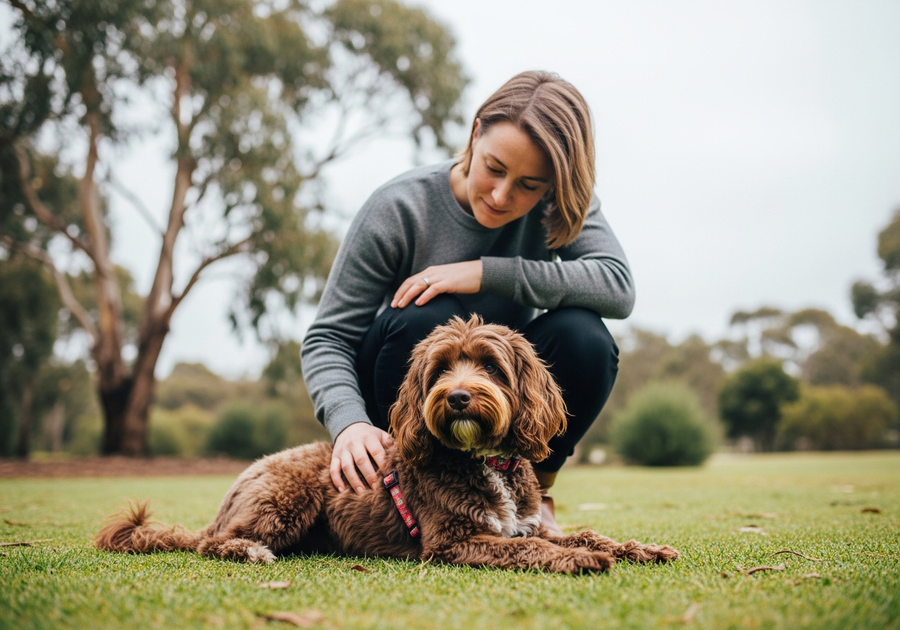
If your Spoodle shows several of these signs consistently, it is worth speaking with your vet to rule out any underlying physical causes before focusing exclusively on behavioural or supplement-based approaches. Pain and illness can present with similar behavioural changes, and your vet can help you distinguish between the two.
What to Look for in a Calming Supplement
The supplement market for dog anxiety is large and not always transparent. Understanding what the evidence actually supports helps you cut through the noise and choose a product that has a reasonable chance of working for your Spoodle.
L-tryptophan is an amino acid the body uses to synthesise serotonin, the neurotransmitter most closely linked to mood stability and calm behaviour. A 2020 study published in Frontiers in Veterinary Science found that dogs receiving dietary L-tryptophan supplementation showed significant reductions in anxiety-related behaviours over an eight-week trial period. For a breed as emotionally attuned as the Spoodle, this is one of the most relevant ingredients to prioritise.
Magnesium plays a direct role in nervous system regulation. Dogs under ongoing stress deplete magnesium more rapidly than usual, and lower magnesium levels are associated with a heightened anxiety response. Daily supplementation helps keep levels stable in dogs who are chronically reactive or stressed.
Ashwagandha is an adaptogen, meaning it helps regulate the body's stress response rather than simply suppressing arousal. Research on ashwagandha in companion animals points to its role in reducing cortisol-related stress over time. It keeps your dog alert and present while helping them become less reactive over time. For a smart, alert breed like the Spoodle, you want something that takes the edge off reactivity without dulling their personality.
Chamomile is one of the most thoroughly researched herbal calming agents used in both human and veterinary contexts. Gentle and well-tolerated, it supports relaxation and is particularly effective as part of a multi-ingredient blend rather than as a standalone ingredient.
Jerusalem Artichoke functions as a prebiotic, supporting the gut microbiome. This connects to anxiety through the gut-brain axis, a bidirectional communication pathway between the digestive system and the nervous system. Research published in Applied Animal Behaviour Science has documented significant links between gut health and stress reactivity in dogs, making prebiotic support a meaningful addition to a calming formula.
Vitamin B1 (thiamine) supports normal neurological function and is often included in calming blends for its role in maintaining stable nerve signalling under stress.
What to avoid: products with a single active ingredient at vague dosages, any supplement marketed for causing drowsiness or immediate knock-out calm, and proprietary blends that do not disclose individual ingredient amounts. Transparency on the label is a basic standard of quality.

How Calming Supplements Work for Spoodles
The most common misunderstanding about calming supplements is the expectation that they work like a fast-acting medication you give once before a stressful event. That is not how they work, and they are not designed that way. Ingredients like L-tryptophan, ashwagandha, and magnesium work by supporting the body's stress regulation systems over time. That means they need consistent daily use to have a meaningful effect.
Most Spoodle owners who give a quality calming supplement every day report noticeable changes in baseline anxiety within two to four weeks of consistent use. Giving a chew once before a fireworks night and deciding the product does not work is not a fair trial. The same logic applies to any supplement: the cumulative effect is what matters, not the acute dose.
This is also why the format matters. A daily soft chew given at the same time each morning becomes part of the routine, which is itself calming for routine-dependent breeds like Spoodles. It is a small, consistent act of care that supports both the biochemistry and the behavioural structure your dog needs. For a broader overview of anxiety management strategies that go beyond supplementation, the guide to dog anxiety covers the full picture, including behavioural modification and when to involve a vet.
For dogs with significant separation anxiety or generalised anxiety disorder, supplements work best as one component of a broader management plan that includes a consistent daily routine, appropriate mental stimulation, and in more serious cases, a behavioural programme guided by your vet. Supplements support the system; they do not replace the foundations.
Hero Calming Daily Chews for Spoodles
Hero's Calming Daily Chews bring together Magnesium, L-Tryptophan, Vitamin B1, Jerusalem Artichoke, Ashwagandha, and Chamomile in a soft chew format your Spoodle will treat as a snack. Each of these ingredients has a defined role in supporting the body's calming systems, and together they address multiple pathways simultaneously rather than relying on a single mechanism.
The formula is vet-reviewed and made in Australia. Each pack contains approximately 60 chews, giving you two full months of daily support. At $59.95 per pack, or $50.96 on a subscription (15% off), it is one of the more practical calming options on the Australian market. A lifetime money-back guarantee means you can try it without financial risk if your Spoodle does not respond.
Because Spoodles benefit from gut-brain support alongside direct calming ingredients, it is worth knowing that gut health and anxiety are closely connected in this breed. If your Spoodle also has a sensitive stomach or has recently been through a round of antibiotics, supporting the gut microbiome alongside the nervous system is worth considering. The calming chews include Jerusalem Artichoke for this reason, but dedicated probiotic support is another option your vet can advise on.
Not sure which supplement makes sense for your Spoodle's age, weight, and lifestyle? The Hero Health Assessment takes two minutes and gives you a personalised recommendation based on your dog's specific profile.
Start the Free AssessmentBuilding a Calming Routine That Works for a Spoodle
A supplement is one input in a system. For Spoodles, the system matters enormously. They are creature-of-habit dogs who find predictability calming in itself, so building a consistent daily structure gives any supplement the best possible environment to work in.
Practical steps that support calming supplement effectiveness in Spoodles:
- Give the calming chew at the same time each morning, ideally alongside breakfast, so the supplementation becomes part of a predictable daily rhythm
- Create a deliberate departure routine you repeat exactly the same way every time, reducing the anticipatory anxiety that builds around variable departure cues
- Include mental stimulation as a non-negotiable part of every day: puzzle feeders, scent games, and short training sessions all help a Spoodle's busy mind wind down into a calmer baseline
- Establish a calm space your Spoodle can choose when overstimulated, whether that is a crate, a specific room, or a mat with familiar bedding and scent
- Keep exercise consistent in timing and duration as much as possible, as irregular schedules can increase baseline anxiety in sensitive breeds
Joint health is also worth keeping in mind as your Spoodle ages. Dogs in physical discomfort tend to have a lower anxiety threshold, and Spoodles can be prone to joint problems as they get older. If your dog is also starting to show signs of stiffness or reluctance to exercise, the guide to best joint supplements for Spoodles covers what to look for and when to start.
For Spoodles with significant anxiety, particularly separation distress that involves destructive behaviour or prolonged distress vocalisations, speak with your vet before relying on supplements alone. A certified veterinary behaviourist can help you address the root cause rather than just managing the surface behaviours. Supplements work best when the fundamentals of routine, stimulation, and environment are also in place.
Understanding how your Spoodle's needs will change over the course of their life also helps you plan proactively. The Spoodle lifespan guide outlines how their health and behavioural tendencies shift with age, which affects how you calibrate calming support as they move from puppy into senior years.
The Bottom Line
Spoodles are emotionally engaged, highly intelligent dogs who thrive on connection and routine. Their tendency toward anxiety is the flipside of the qualities that make them such wonderful companions. Managing it well means choosing a calming supplement with the right ingredient profile, giving it consistently every day, and pairing it with the predictable structure and mental engagement this breed genuinely needs.
The ingredients most supported by veterinary research for dogs with anxiety are L-tryptophan, magnesium, ashwagandha, chamomile, and gut-supporting prebiotics. A daily chew format that includes all of these is the most practical option for most Spoodle owners. Allow two to four weeks of consistent use before assessing results.
Every Spoodle is different. If you want a personalised recommendation based on your dog's specific age, weight, and health profile, the Hero Health Assessment takes under two minutes and will point you in the right direction.