

Maltese dogs have one job: to be with their person. It's what they've been bred for across thousands of years, from ancient Mediterranean palaces to modern Australian apartments. That closeness is their greatest quality. It's also the source of a lot of anxiety. If your Maltese cries when you leave the room, follows you everywhere, or seems to spiral the moment something unexpected happens, you're not imagining things. This is a breed that feels things deeply and bonds tightly.
The good news is that calming supplements, used consistently as part of a daily routine, can genuinely help. This guide covers what to look for, which ingredients are backed by research, and how to build a calm-supporting routine that works for small, sensitive dogs like the Maltese.
Why Maltese Dogs Are So Prone to Anxiety
Maltese dogs have been companion animals for a very long time. Historical records place them as favoured lap dogs in ancient Greece and Rome, and they've spent millennia being selected for closeness to humans rather than independence. Unlike working breeds that can switch off when not on task, the Maltese never really evolved an "off" mode. Their whole purpose has always been presence.
That history shows up in their behaviour today. Maltese are what trainers sometimes call "velcro dogs." They track your movements, read your mood, and adjust their own emotional state to yours. This makes them extraordinarily attuned companions. It also makes them vulnerable to separation anxiety, noise sensitivity, and generalised stress when their routine is disrupted.
Their small size adds another layer. At 3 to 4 kilograms, the world genuinely is bigger and louder relative to their body. Sounds that barely register for a larger dog can startle a Maltese. Unfamiliar people, new environments, and even changes in your schedule can tip a sensitive Maltese into anxious territory. For a full picture of the health challenges Maltese face, the complete guide to Maltese health issues covers what owners need to know at each life stage.
Signs Your Maltese May Be Anxious
Anxiety in small dogs doesn't always look dramatic. Some Maltese shut down quietly rather than making noise. Others become frantic and destructive. Recognising the signs early matters because anxious behaviour tends to escalate when it's not addressed.
Common signs to watch for include:
- Excessive barking or whining when left alone, even briefly
- Shadowing you through the house and refusing to settle independently
- Trembling or shaking in new environments or around unfamiliar people
- Destructive behaviour near exits, especially doors and windows
- Panting, yawning, or lip-licking in situations that aren't physically demanding
- Toileting accidents despite being reliably house-trained
- Reduced appetite during stressful periods
If your Maltese is showing several of these signs consistently, it's worth a conversation with your vet before starting any supplement. According to VCA Animal Hospitals, anxiety in dogs is one of the most commonly under-recognised behaviour concerns, and early intervention consistently produces better outcomes than waiting. Supplements work well as daily support for mild to moderate anxiety, but separation anxiety in Maltese can sometimes require a combination of behavioural strategies, environmental changes, and professional guidance to address properly. Your vet can help you understand where your dog sits on that spectrum.
What to Look for in a Calming Supplement for Maltese
The calming supplement market is large and inconsistent. Some products rely on herbal ingredients that dull dogs rather than genuinely supporting calm behaviour. Others are dosed for larger breeds and aren't appropriate for a 3 to 4 kilogram Maltese. Here's what the evidence supports for small companion dogs.
Magnesium
Magnesium is essential for healthy nervous system function, and it's one of the nutrients most commonly depleted during chronic stress. When magnesium is low, the nervous system becomes more reactive, which creates a cycle where stress reduces magnesium and low magnesium amplifies stress sensitivity. Daily magnesium supplementation can help stabilise that cycle.
L-Tryptophan
L-Tryptophan is an amino acid that the body uses to produce serotonin, the neurotransmitter most associated with mood stability and calm. Research published in the Journal of Veterinary Behavior found that dietary tryptophan supplementation was associated with measurable reductions in anxiety-related behaviour in dogs, particularly in noise-sensitive individuals. Given that Maltese often show heightened noise sensitivity, this ingredient is particularly relevant.
Ashwagandha
Ashwagandha is an adaptogenic herb used historically to support the body's response to stress. Adaptogens work by helping regulate cortisol, the primary stress hormone, which rises during anxious episodes. For dogs with generalised or chronic anxiety rather than purely situational fear, ashwagandha may help bring baseline stress levels down over time. At appropriate companion animal doses, it's considered safe and well-tolerated.
Chamomile
Chamomile contains apigenin, a compound that binds to the same receptors targeted by calming medications but at a much milder level. It's gentle enough for daily use and pairs well with other calming ingredients. By itself, chamomile won't resolve significant anxiety, but as part of a broader formula it contributes meaningfully to a calmer baseline.
Vitamin B1 (Thiamine)
Vitamin B1 is a key nutrient for neurological function. Like magnesium, it tends to be depleted during periods of stress, and low B1 levels are linked to increased nervous system reactivity. Regular daily intake helps maintain the kind of stable nerve function that underlies consistent calm behaviour.
Jerusalem Artichoke
Jerusalem artichoke is a prebiotic fibre source that feeds beneficial bacteria in the gut. The connection between gut health and mood is increasingly well-established through what researchers call the gut-brain axis. A 2022 review in Frontiers in Neuroscience highlighted how gut microbiome composition influences neurotransmitter production, including serotonin and GABA, both of which are involved in regulating anxiety. A healthy gut environment supports a calmer mind.
Daily Routine vs Situational Use
One of the most frequent mistakes with calming supplements is using them only when something stressful is happening. For a Maltese with chronic background anxiety, this approach is largely ineffective. The nervous system doesn't switch off and on cleanly based on external events. The underlying reactivity is always present; the stressor just makes it visible.
Ingredients like magnesium, L-tryptophan, and ashwagandha work cumulatively. You're building a calmer baseline over time, not flipping a switch. Most owners notice the biggest difference after 3 to 4 weeks of consistent daily use, and it shows up in subtle ways first: a Maltese that settles more easily after you return, one that doesn't spiral when the routine shifts slightly, one that sleeps through minor outdoor sounds instead of alerting to each one.
For events like fireworks or travel, a daily supplement reduces the reactivity threshold, meaning those events hit a dog that's already calmer to begin with. The guide to managing storm and fireworks anxiety in Australian dogs goes deeper on situational strategies that combine well with daily calming support.
The gut-brain connection is worth supporting alongside calm behaviour. Anxious Maltese often have sensitive digestion, and probiotic support for Maltese can complement a calming supplement by maintaining a healthy gut environment that underpins stable mood.
Choosing the Right Format for a Maltese
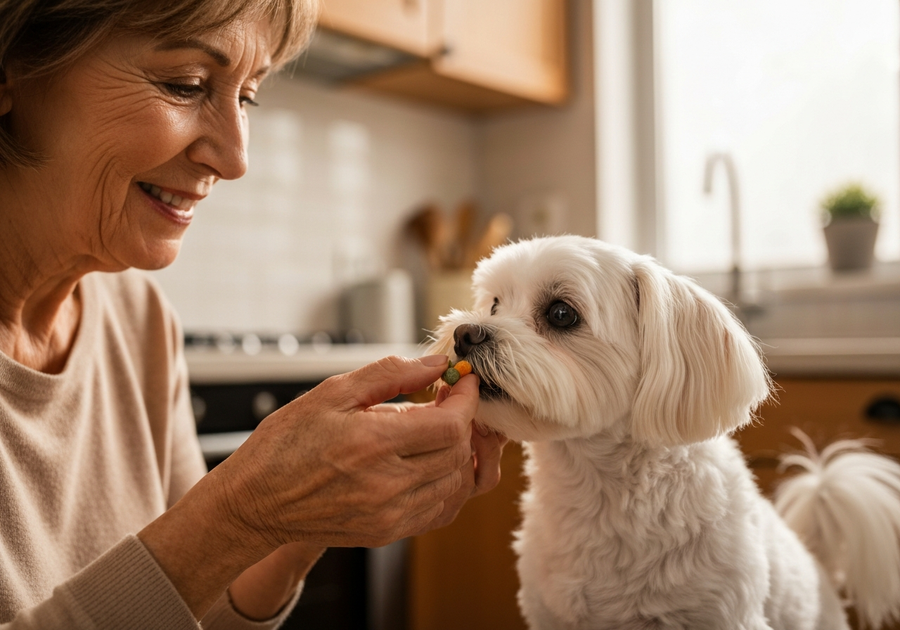
Maltese can be fussy. Their small mouths, selective preferences, and tendency to inspect everything before accepting it makes format an important consideration. Pills are easy to refuse. Powders require accurate dosing that's harder to achieve for a very small dog. Soft chews that are flavoured palatably tend to work best, especially when they're small enough that the dog accepts them as a treat rather than a supplement.
Look for a chew that is:
- Grain-free and free from artificial fillers (Maltese can have sensitivities)
- Dosed by weight so you can calculate the right amount for a small dog
- Vet-reviewed and manufactured in Australia for regulatory oversight and freshness
- Backed by a satisfaction guarantee, which signals the brand is confident in the formula
The chew format has another advantage beyond palatability. Giving it at the same time each day creates a small daily ritual that becomes its own positive moment. Your Maltese starts associating the chew with calm, consistent attention from you. Over time, the routine itself becomes part of the calming signal.
Hero Calming Daily Chews: What Maltese Owners Should Know
Hero's Calming Daily Chews contain magnesium, L-tryptophan, Vitamin B1, Jerusalem artichoke, ashwagandha, and chamomile. The formula is vet-reviewed, made in Australia, and free from grain and artificial additives. Each pack contains around 60 chews, and dosing is weight-based, which makes it straightforward for the typical Maltese weight range of 3 to 4 kilograms.
The chew format means you're not hiding pills or measuring powders. Most Maltese accept them readily as part of the morning routine. A lifetime money-back guarantee means you can try the formula without risk. You can read real experiences from other Australian dog owners on the product page, which gives you a better sense of how the supplement performs across different situations and temperaments.
Not sure where to start with your Maltese's health? The Hero Health Assessment takes 2 minutes and gives you a personalised supplement plan based on your dog's age, weight, and lifestyle.
Start the Free AssessmentSupporting Your Maltese's Calm Beyond the Supplement
Calming supplements work best as part of a considered daily routine. A few things that compound well with daily supplementation:
- Predictable daily structure: Maltese settle better when meal times, walks, and departures happen at consistent times. Unpredictability is its own stressor for a breed this sensitive.
- A designated safe space: A crate, pen, or corner that belongs to your Maltese, is always available, and is never associated with punishment. This gives them somewhere to retreat when the world feels like too much.
- Calm departures and arrivals: Drawn-out goodbyes and excited greetings reinforce that your absence is a significant event. Brief, matter-of-fact departures and low-key arrivals help normalise your comings and goings.
- Daily movement: Even a 20-minute walk with genuine sniffing opportunity makes a difference. Mental stimulation through sniff work and light training games helps Maltese channel their energy constructively.
- Gradual alone-time training: For dogs with significant separation anxiety, building tolerance for independence in small increments (starting with seconds, not minutes) is more effective than simply leaving them alone and hoping they adjust.
If your Maltese is getting older and showing changes in behaviour alongside other physical signs, it's worth a closer look. Cognitive changes in senior dogs can overlap with anxiety and sometimes drive it. Understanding your dog's overall health picture, including Maltese lifespan and what to expect as they age, helps you make better decisions about what kind of support they need at each stage.
The Bottom Line
Maltese dogs are anxious because they care, deeply and completely, about their people. That's not a problem to fix; it's a characteristic to understand and work with. Calming supplements with the right ingredients, given daily as part of a consistent routine, give these small, sensitive dogs the neurological support they need to manage a world that often feels too loud, too unpredictable, and too full of absences.
Every Maltese is different. If you want a personalised supplement plan based on your dog's specific age, weight, and lifestyle, the Hero Health Assessment takes under two minutes and gives you a tailored starting point.