

If your Maltese has ever had a bout of loose stools, gassy discomfort, or skin that's been itchier than usual, there's a good chance their gut is involved. Small breeds like the Maltese are often more sensitive to dietary changes, stress, and even the wrong probiotic formula than larger dogs. The good news is that targeted gut support can make a real difference, and probiotics have become one of the most researched daily supplements for dogs in Australia.
Why Maltese Have Sensitive Digestive Systems
The Maltese is a toy breed with a digestive tract to match. While their small size is part of what makes them so well-suited to apartment living, it also means their gut has less reserve when things go wrong. A diet change that a Golden Retriever would barely notice can leave a Maltese with loose stools for a week.
Beyond size, the Maltese is known for being allergy-prone. Skin reactions, food sensitivities, and itching are among the most common Maltese health problems owners report. The connection between gut health and skin health is well-established in both human and veterinary medicine. A compromised gut lining can allow proteins to pass into the bloodstream and trigger immune responses, which often show up on the skin first.
Maltese dogs are also frequently prescribed antibiotics for dental infections, respiratory issues, and skin conditions they are prone to. Antibiotics disrupt the gut microbiome significantly, and many vets now recommend probiotic support during and after antibiotic courses. Understanding the full picture of breed health helps, and our guide to common Maltese health problems covers the conditions most likely to affect your dog across their lifetime.
What Probiotics Can Do for Your Maltese
Probiotics are live microorganisms that, when given in adequate amounts, support a healthy balance in the gut. For a Maltese, the main benefits fall into a few key areas.
Digestion and stool quality tend to improve first. Dogs with a more balanced gut microbiome produce firmer stools, experience less gas, and are generally more comfortable after meals. For Maltese owners who have been dealing with inconsistent digestion, this is often the first change they notice within the first two weeks of starting a probiotic.
Immune function is the less obvious but arguably more important benefit. Around 70% of the immune system is located in the gut, and keeping that environment balanced has downstream effects on how well your Maltese handles everything from seasonal allergies to infections. A 2023 review in Frontiers in Veterinary Science noted that probiotic supplementation in dogs was consistently associated with improved mucosal immune response and better resistance to gastrointestinal pathogens.
Nutrient absorption also improves with a healthier gut. Maltese are small dogs who need dense nutrition from every meal. When the gut is not functioning well, some of that nutrition passes through without being fully absorbed. A daily probiotic helps create the conditions for better absorption, which can show up as improved energy, coat quality, and general vitality over months of consistent use.
What to Look for in a Probiotic for Your Maltese
Not all probiotics are made the same, and many common formulas are not necessarily the best fit for a Maltese specifically. Here is what actually matters when choosing.
Strain selection
Most dog probiotics use bacterial strains, typically Lactobacillus or Bifidobacterium. These can be effective, but they have one significant limitation: they do not survive antibiotic treatment. If your Maltese is on antibiotics (a common occurrence for this breed), a bacterial probiotic is essentially ineffective during that period.
Saccharomyces boulardii takes a different approach. It is a yeast, not a bacterium, which means antibiotics do not affect it. You can give it alongside a course of antibiotics and the probiotic remains fully active. S. boulardii has specific evidence for supporting dogs recovering from antibiotic-associated diarrhoea, which is a real concern for Maltese who tend to need antibiotics more than some breeds. The AKC's guide to probiotics for dogs explains how yeast-based probiotics function differently from bacterial strains at the gut level, making them particularly relevant during antibiotic courses. For a dog recovering from antibiotics, this distinction matters considerably.
Hypoallergenic formulation
Maltese are among the more allergy-prone breeds in Australia. A probiotic that contains wheat, grain fillers, or common allergens can trigger the very reactions you are trying to support your dog through. Look for a formula that is grain-free, wheat-free, and free from common protein allergens.
Australian-made and vet-reviewed
Given that this is going into your dog's mouth every day, manufacturing standards matter. Australian-made supplements are subject to local regulatory oversight. Choosing a vet-reviewed formula means a qualified professional has assessed the formulation and dosing approach.

Not sure where to start with your Maltese's health? The Hero Health Assessment takes 2 minutes and gives you a personalised supplement plan based on your dog's age, weight, and lifestyle.
Start the Free AssessmentS. boulardii vs Bacterial Probiotics: An Honest Comparison
The probiotic market for dogs is dominated by bacterial strain products, and many of them work well for dogs without allergy sensitivities or frequent antibiotic use. But for the Maltese specifically, the picture is different.
Here is a practical way to think about it. If your Maltese is generally healthy, eats a consistent diet, and rarely needs antibiotics, a quality bacterial probiotic can be a solid choice. But if your dog is one of the many Maltese who cycles through antibiotic courses for dental infections, skin issues, or ear problems, a yeast-based probiotic like S. boulardii makes more sense as a daily supplement because it remains active regardless of what else is being given.
S. boulardii also has good evidence for supporting dogs with sensitive stomachs, which overlaps heavily with the Maltese health profile. A 2022 study in the Journal of Veterinary Internal Medicine found that S. boulardii supplementation in dogs with chronic gastrointestinal issues reduced the frequency of loose stool episodes over a 12-week observation period compared to placebo.
No probiotic should replace veterinary care if your Maltese is showing signs of serious gastrointestinal illness. Persistent vomiting, blood in the stool, or significant weight loss are all reasons to see your vet rather than trial a supplement first.
How to Introduce Probiotics Into Your Maltese's Routine
Starting any new supplement with a small dog requires a bit of patience. Maltese tend to be sensitive to changes, and a new addition to their diet, even one designed to help, can occasionally cause an adjustment period of loose stools or gas during the first week.
Starting with half a dose for the first seven days gives the gut time to adapt. After that, you can move to the full daily amount. Most chew-format probiotics are dosed by weight, so a Maltese at 3 to 4 kg will typically need less than a larger breed.
Consistency matters more than timing. Taking a probiotic on some days but not others does not build a stable gut microbiome. Many Maltese owners find that giving the chew alongside the morning meal makes it easy to remember. Daily supplementation over weeks and months produces the most meaningful results, as the gut microbiome takes time to shift and stabilise. Not every dog responds at the same rate, and some Maltese show improvement quickly while others take four to six weeks to show clear changes.
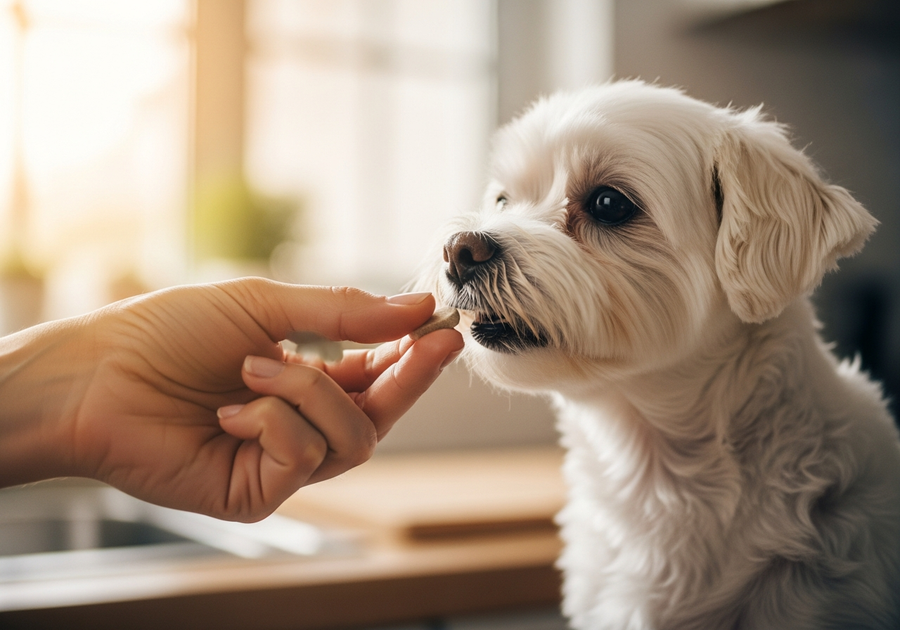
Soft chew formats are generally much easier to get into a small dog than powder or capsule alternatives. Many Maltese are enthusiastic about chews offered as a standalone treat rather than something mixed into food.
Signs Your Maltese Could Benefit From Probiotic Support
Not every Maltese needs a probiotic supplement. But there are some common patterns that suggest gut support could make a difference.
Loose or inconsistent stools without an obvious dietary cause are one of the clearest signals. If your Maltese has firmer stools some weeks and soft or runny stools others without any clear reason, gut microbiome instability is worth addressing.
Frequent gas or bloating, particularly after meals, is another sign. Some Maltese are notably gassy despite being fed quality food. The gut bacteria responsible for breaking down certain fibres can produce excess gas when the microbiome is out of balance.
Skin itching or recurring skin irritation, even after ruling out external parasites and food allergens, can point to a gut-skin connection worth exploring with your vet. If your Maltese has chronic skin issues with no clear trigger, gut support may be part of a broader management plan.
Any Maltese who has recently completed a course of antibiotics is a strong candidate for probiotic support. Antibiotics do their job of clearing bacterial infections, but they do not distinguish between harmful and beneficial bacteria. A yeast-based probiotic like S. boulardii can be started on the first day of an antibiotic course and continued through and after treatment. Understanding your Maltese's lifespan and long-term health trajectory helps put these decisions into the bigger picture of lifelong care.
The Bottom Line
For the Maltese, gut health connects to a lot of what owners commonly deal with: skin reactions, digestive inconsistency, and the regularity of antibiotic courses that can disrupt the microbiome each time. A daily probiotic, particularly one based on S. boulardii given its antibiotic-safe properties, is a reasonable addition to the routine for many Maltese.
Quality matters. Look for grain-free, hypoallergenic formulas made in Australia and vet-reviewed. Hero's Probiotic Daily Chews use 10 Billion CFU of S. boulardii per chew, are grain-free and wheat-free, and are proudly made in Australia with a vet-reviewed formula backed by a lifetime money-back guarantee. Every Maltese is different, and if you want to know exactly what your dog needs, the Hero Health Assessment will give you a personalised recommendation in under two minutes.