

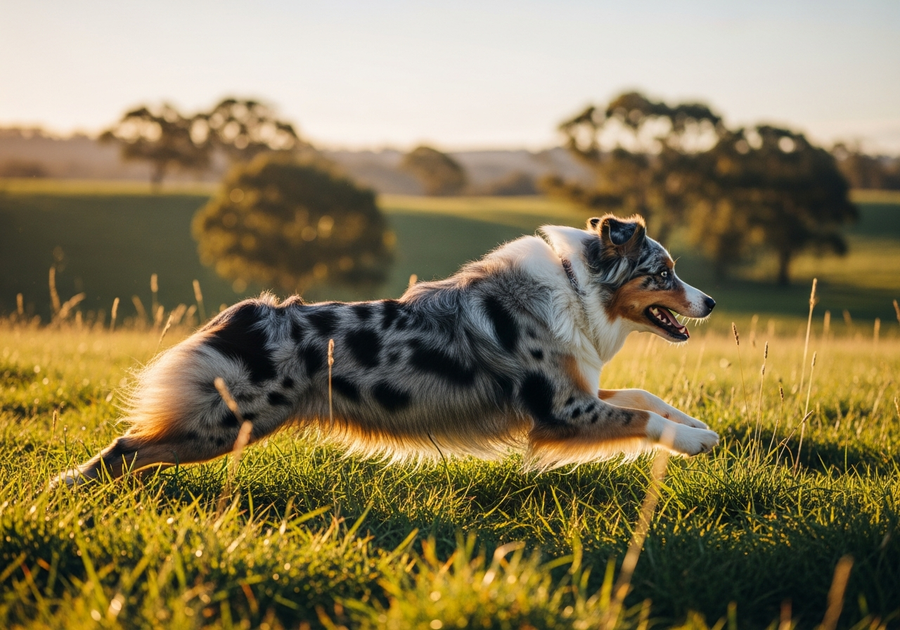
If you share your life with an Aussie, you already know they don't do anything by halves. They bolt across the backyard at full tilt, leap onto the couch mid-conversation, and herd the kids back into the kitchen at dinner time. That same drive is exactly why their joints take a beating earlier than most owners expect, and why a daily joint supplement is one of the more sensible things you can add to your dog's routine before there's a problem to fix.
This guide walks through what Australian Shepherds actually need for joint support, which ingredients have research behind them, and how to choose a daily chew that fits the breed. It is written for Australian owners and pulls on independent veterinary research alongside Australian clinical practice.
Why Australian Shepherds Need Joint Support Earlier Than Most Owners Realise
Aussies were bred to work, and the structure of the breed reflects that. They are medium-sized, deep-chested, and built for sudden direction changes at high speed. According to the Orthopedic Foundation for Animals, hip dysplasia remains one of the most commonly tracked orthopaedic conditions across herding breeds, and Aussies sit firmly inside that risk group along with Border Collies and German Shepherds.
Our breed guide on common Australian Shepherd health problems every owner should know covers the full picture, but joint issues sit near the top of the list. Hip dysplasia, elbow dysplasia, and early-onset arthritis are the three most common reasons an Aussie owner ends up in a Perth, Sydney, or Melbourne vet clinic asking about mobility.
The frustrating part for owners is how late the symptoms show. A young Aussie tearing around an off-leash park looks indestructible. Then around five or six, you start to notice they pause before jumping into the back of the ute. The reluctance creeps in slowly. By the time it's obvious, the cartilage damage often has a head start of a few years.
This is the case for starting joint support early rather than waiting for limping. Daily nutritional support won't reverse a structural problem, but it gives the cartilage and connective tissue better building blocks while your dog is still moving well.
What Actually Causes Joint Problems in Australian Shepherds
Three factors stack on top of each other in this breed.
Genetics. Aussies carry a higher base rate of hip and elbow dysplasia than the average mixed-breed dog. Reputable Australian breeders now screen parents through PennHIP or OFA scoring, but plenty of pet-line Aussies were bred without those checks. If your dog came from a backyard or pet-shop litter, assume the genetic risk is real.
If hip dysplasia is already on your radar, our deeper guide to Australian Shepherd hip dysplasia prevention and treatment covers diagnosis, management, and what to expect at different life stages.
Workload. The same intensity that makes Aussies brilliant working dogs is rough on cartilage. Frisbee dogs, agility dogs, dogs that fetch a ball for two hours every Saturday, and farm Aussies clocking serious daily kilometres all rack up cumulative joint stress. The damage is invisible until it isn't.
Body condition. Even a couple of extra kilograms changes the load through the hip and stifle. The 2017 randomised controlled trial published in BMC Veterinary Research on dietary support for canine osteoarthritis reinforced what most vets already knew clinically: lean dogs experience less pain and better mobility scores than overweight dogs at the same age, regardless of supplementation. Weight management is the single biggest non-negotiable for joint health in this breed.
The Two Main Approaches You Will See on the Shelf
Joint supplement marketing in Australia is a noisy space, but most products fall into one of two camps.
The cartilage-precursor approach uses glucosamine, chondroitin, and green-lipped mussel as the headline ingredients. These have decades of clinical use, plenty of vets still recommend them, and they are perfectly legitimate options. Head-to-head efficacy data is mixed, but the safety profile is well established and many dogs do well on these formulas.
The collagen and anti-inflammatory approach uses hydrolysed collagen peptides as the structural building block, paired with anti-inflammatory and antioxidant ingredients like methylsulfonylmethane (MSM), turmeric, and vitamin C. The thinking here is to give the body raw material for tissue repair plus support for the inflammation that drives cartilage breakdown.
Neither approach is universally better. The right one for your Aussie depends on what your dog has responded to before, what your vet recommends, and which format your dog will actually eat every day for the next decade. The rest of this guide focuses on the second approach, because that is where most of the recent veterinary research sits.
The Ingredients That Actually Move the Needle
Within the collagen and anti-inflammatory category, four ingredients stand out for the strength of the research behind them and the relevance to a high-activity breed like an Aussie.
MSM (Methylsulfonylmethane)
MSM is a naturally occurring sulphur compound. According to VCA Animal Hospitals, MSM is used most often in dogs and horses for its anti-inflammatory and antioxidant properties, particularly in arthritis cases. Sulphur is a structural component of cartilage and connective tissue, so adequate dietary sulphur supports the body's ongoing repair work.
Most of the strongest MSM evidence comes from human knee osteoarthritis trials, but veterinary use is well established and the safety profile is good across decades of clinical use.
Hydrolysed Collagen Peptides
Collagen is the protein that makes up cartilage, tendon, and ligament. Hydrolysed collagen peptides are smaller fragments that the body absorbs and uses as raw material for tissue repair. A double-blind, placebo-controlled study in 42 dogs with osteoarthritis found that a daily diet supplemented with hydrolysed collagen, curcuminoid extract, and green tea extract produced a significant reduction in pain on manipulation compared with the control group over three months.
That study matters because it tested the combination owners actually buy, not a single ingredient in isolation.
Turmeric (Curcumin)
Turmeric is the rhizome the spice comes from, and curcumin is its main active compound. The 2023 review on turmeric and curcumin in humans versus dogs notes that curcumin's anti-inflammatory mechanism works through inhibiting NF-κB signalling and matrix metalloproteinase activity, both of which are involved in cartilage breakdown. Curcumin is fat-soluble and absorbs better when paired with a fat source, which is why daily chews work well as a delivery format.
Vitamin C (Ascorbic Acid)
Dogs synthesise their own vitamin C, but the body uses it heavily during collagen synthesis and oxidative stress recovery. For a hard-working breed like an Aussie, supplemental ascorbic acid is a useful cofactor for the collagen pathway, especially through periods of intense activity or recovery from injury.
How to Choose a Joint Supplement for Your Australian Shepherd
Use this as a checklist when comparing products in the pet shop or online.
1. Look for transparent dosing. A good label states active ingredient quantities per chew rather than hiding behind a proprietary blend. If a brand won't tell you how much of each active ingredient is in each chew, treat that as a flag.
2. Match the format to your dog. Aussies are food-motivated and most will treat a soft chew like a snack. Powders mixed into food work, but the dose can drift if your dog leaves food in the bowl. Tablets are reliable but a hard sell with a fussy eater.
3. Check the manufacturing origin. Australian-made supplements are produced under TGA-aligned manufacturing standards and use ingredients sourced under local biosecurity rules. This is a traceability point more than a patriotism one. Active ingredient origin is genuinely easier to verify in a locally manufactured product.
4. Avoid stacking products that overlap. If your dog already eats a kibble formulated for joint support, adding a high-dose joint supplement on top can push some ingredients above the useful range. Read the labels and talk to your vet before doubling up.
5. Think about the next ten years. The supplement that works is the one your dog will eat daily, year after year. Format compliance matters more than the perfect formula on paper.
When to Start Joint Support for an Australian Shepherd
Working backwards from when problems usually appear, most Australian vets we have spoken to suggest starting daily joint support somewhere between three and five years of age for active Aussies. The logic is preventative. Cartilage repair is most efficient in younger dogs, so giving the body better raw materials before damage accumulates is more useful than trying to play catch-up at age nine.
That said, every Aussie is different. A high-drive agility dog might benefit from earlier support. A low-key companion Aussie that lounges most of the day might wait until the first signs of stiffness. The Australian Shepherd lifespan and what affects it guide goes deeper into how lifestyle stages map to health planning across the breed's typical 12 to 15 year span.
Not sure where to start with your Aussie's joint routine? The Hero Health Assessment takes about two minutes and gives you a personalised supplement plan based on your dog's age, weight, breed, and activity level.
Start the Free AssessmentSigns Your Australian Shepherd Might Already Need Joint Support
Aussies hide discomfort well. They are working dogs by temperament and tend to push through stiffness rather than show it. Watch for these subtle changes rather than waiting for an obvious limp.
- Hesitation before jumping onto the couch, into the car, or up onto the bed they used to fly onto
- Stiffness in the first few minutes of a walk that loosens up after warm-up
- Reluctance to play fetch as long as they used to, or sitting out the second round
- Difficulty getting up from a cold tile floor compared with a soft bed
- Bunny-hopping with the back legs at speed instead of a normal gait
- Licking around a specific joint, especially the hips or stifles
If you tick two or more of these, book a vet check before adding anything new. Joint supplements support the work of veterinary care; they do not replace it. A vet can rule out structural problems, infections, or autoimmune issues that need different treatment.

Hero's Daily Joint Chew at a Glance
Hero's Daily Joint Chew is built around the four collagen-and-anti-inflammatory ingredients covered above: MSM, hydrolysed collagen peptides, turmeric, and ascorbic acid. It is a soft chew, around 60 chews per pack, dosed by body weight, and made in Australia under vet review.
For most Aussies, the daily dose comes in the medium-to-large weight band. The chew is grain-free and free from animal proteins, which matters for owners managing food sensitivities, a known issue in the breed. Pricing sits at $59.95 AUD for a one-time pack, or $50.96 on subscription.
If a collagen-first approach doesn't suit your dog or your vet, that's a fair call. The point is to land on a daily routine that you'll actually keep up.
Daily Routine That Actually Sticks
The supplement is one piece. The rest of the routine matters as much for an Aussie's joints.
Keep them lean. A flat waist viewed from above and ribs you can feel without pressing hard is the goal. Every kilo above ideal weight puts measurable extra force through the hip and stifle.
Vary the surfaces. Long sessions on hard concrete are tougher on joints than mixed terrain. Where you can, swap some pavement walks for grass, sand, or bush trails.
Build in low-impact exercise. Swimming is brilliant for Aussies. The breed is generally happy in water, and the buoyancy lets them work the muscles that stabilise the joints without the impact load.
Warm them up. A five-minute lead walk before letting them off-leash to sprint is a small habit that makes a real difference, especially in cooler Australian winters.
Don't skip vet checks. An annual mobility check from age five onwards catches early changes when intervention options are widest. Your vet can also adjust dosing or recommend additional support if your dog has had an injury.
The Bottom Line on Joint Supplements for Australian Shepherds
Australian Shepherds are athletic, hard-charging dogs with a higher-than-average risk of hip and elbow joint problems. Starting daily joint support somewhere between three and five years old, keeping them lean, and varying the surfaces they work on gives the body the best chance of staying mobile through their senior years.
Look for a formula with transparent dosing, ingredients backed by veterinary research, and a format your dog will actually eat every day for years. The right product for your Aussie comes down to what your vet recommends and what your dog will reliably eat. The daily habit is what matters.
If you want a personalised starting point for your Aussie, the Hero Health Assessment walks you through a short set of questions and produces a plan based on your dog's profile in under two minutes.