

If you have a Chihuahua, you probably know the look. The one they give you after wolfing down something new, or after a stressful afternoon. A little hunched. A little sorry for themselves. Maybe a puddle of trouble by the back door.
Chihuahuas have some of the most sensitive digestive systems of any breed. It is not bad ownership, and it is not bad luck. It is biology. Their small size, fast metabolism, and tendency to take stress straight to the stomach means that gut problems come with the territory.
Probiotics have become one of the more effective daily tools for managing this. Not as a cure for anything specific, but as ongoing gut support that keeps things more stable day to day. Here is what you need to know before choosing one.
Why Chihuahuas Have Notoriously Sensitive Tummies
Small dogs process food differently from larger breeds. Their gastrointestinal systems work fast, and there is less room for error when something does not agree with them. A dietary change that a Labrador shakes off without incident can send a Chihuahua into a bout of loose stools within hours.
There is also the stress factor. Chihuahuas are bold little dogs with big personalities, but they can be surprisingly reactive to changes in their environment. A new visitor, a trip to the vet, a change in routine. For many Chihuahuas, stress and stomach problems are closely linked, which is something that often catches new owners off guard. You can read more about the broader health patterns in this breed in our guide to common Chihuahua health problems.
Dental disease is another factor worth knowing about. Chihuahuas are prone to dental problems due to their crowded teeth, which means they often need antibiotic treatment as part of dental care. Antibiotics can disrupt gut bacteria significantly, and post-antibiotic digestive issues are extremely common in small dogs. This makes the choice of probiotic particularly relevant for the breed, but more on that below.
Signs Your Chihuahua's Gut May Need Support
Gut imbalance in dogs does not always look dramatic. Some Chihuahuas show obvious signs: loose or inconsistent stools, excessive gas, or vomiting after meals. Others show subtler patterns that are easy to overlook.
Things to watch for include:
- Stools that change texture frequently without an obvious dietary cause
- Excessive gas, gurgling sounds from the stomach, or visible bloating after meals
- Itchy skin or paws (the gut-skin connection in dogs is well documented)
- Low appetite, especially in a dog who is usually food-motivated
- Digestive upset following antibiotic treatment or any change in food
- Increased anxiety or restlessness that seems to coincide with stomach discomfort
None of these signs are proof that a probiotic will fix everything, and ongoing digestive problems always deserve a vet conversation. But they are reasonable signals that gut support could be worth exploring.
How Probiotics Work for Small Dogs
The digestive system relies on a community of microorganisms, bacteria, yeast, and other organisms, that help break down food, absorb nutrients, and maintain the gut lining. When that community is out of balance, you see the symptoms above.
Probiotics introduce beneficial microorganisms to the gut with the goal of restoring or maintaining that balance. According to the American Kennel Club, probiotics for dogs may help with diarrhoea, inflammation, and general gut health, though responses vary between individual dogs.
Research published in peer-reviewed veterinary journals, including work available through PubMed, has continued to explore how probiotic supplementation supports gastrointestinal health in dogs, particularly following disruptions like antibiotic treatment or dietary changes.
The key distinction for Chihuahuas, and the one that most people overlook, is the difference between bacterial probiotics and yeast-based probiotics. Most probiotic products contain bacterial strains like Lactobacillus or Bifidobacterium. These are fine for general maintenance, but they have one significant limitation: they are killed by antibiotics. If your Chihuahua is taking antibiotics for dental treatment or any other reason, a bacterial probiotic taken at the same time simply will not survive the course.
A yeast-based probiotic, specifically Saccharomyces boulardii, works differently. Because it is a yeast rather than a bacterium, antibiotics do not touch it. Research exploring S. boulardii in gut health contexts, such as studies indexed at PubMed, has supported its role in reducing digestive disruption during antibiotic treatment. For a breed that frequently needs dental antibiotics, this matters.
Not sure where to start with your Chihuahua's health? The Hero Health Assessment takes 2 minutes and gives you a personalised supplement plan based on your dog's age, weight, and lifestyle.
Start the Free AssessmentWhat to Look For in a Probiotic for Your Chihuahua
Given the breed's specific sensitivities, a few things are worth prioritising when you are choosing a probiotic.
Yeast-based or antibiotic-safe
As covered above, if your Chihuahua regularly needs antibiotic treatment (common with dental work), a yeast-based probiotic like S. boulardii will keep working throughout the course. This is the main reason it tends to suit the breed better than standard bacterial probiotics.
Grain-free formulation
Many Chihuahuas have food sensitivities, often to grains and wheat. A probiotic that introduces a new irritant alongside the supplement would be counterproductive. Look for a grain-free, wheat-free option, particularly if your dog already has known sensitivities or allergic skin issues.
Appropriate format for a small dog
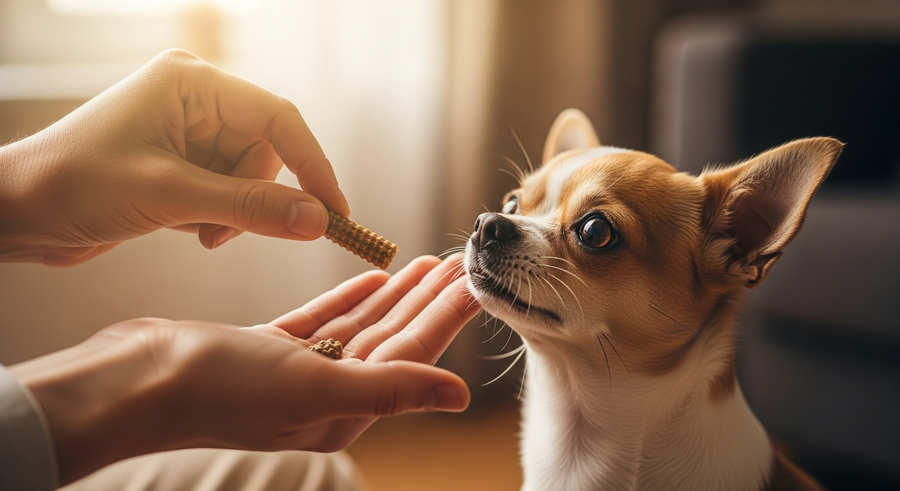
Chihuahuas are notoriously fussy eaters. A soft chew that looks and tastes like a treat is far more practical than a powder you have to disguise in food or a capsule your dog will somehow find and spit out. Consistency matters more than anything with gut support, so the format needs to be something your dog will actually accept daily without a battle.
Prebiotics in the formula
Some probiotics include prebiotics alongside the live cultures. Prebiotics are dietary fibres that feed the beneficial organisms already in the gut, helping them thrive after the probiotic is introduced. A combination product can offer a bit more support than a probiotic alone, though the difference is modest for most healthy dogs.
CFU count
CFU, or colony-forming units, indicates the number of active organisms per dose. More is not automatically better, but you want a meaningful amount. For small dogs, a probiotic with around 10 billion CFU per dose is a reasonable starting point. Products that do not disclose their CFU count on the label are worth approaching with caution, as there is no way to assess whether the dose is therapeutic.
Hero's Probiotic Daily Chews are grain-free and wheat-free, contain 10 billion CFU of Saccharomyces boulardii per chew, and are vet-reviewed and made in Australia. They come in a soft chew format that most dogs accept as a treat. Because the active ingredient is a yeast rather than a bacterium, they continue to work during antibiotic treatment. Find out more at the product page.
French Bulldogs, another small breed with known digestive sensitivity, often respond well to this kind of supplement too. If you are curious how probiotics compare across breeds, our guide to probiotics for French Bulldogs covers similar ground.
How to Introduce Probiotics to a Picky Chihuahua
Chihuahuas can be suspicious of anything new. Starting with a half dose for the first few days and working up to the full dose is a sensible approach. Most dogs tolerate probiotics without any issue, but going slowly avoids any temporary increase in gas or loose stools that can sometimes happen when the gut microbiome is adjusting.
Giving the probiotic with a meal, rather than on an empty stomach, tends to produce better results and better acceptance. For a soft chew, most Chihuahuas will take it straight from your hand or as a between-meal treat once they are used to it.
Consistency is what makes the difference. A probiotic given sporadically does not build the kind of steady gut environment you are aiming for. Daily supplementation as part of a regular feeding routine, similar to the approach many owners take with lifelong health habits for the breed, tends to show better results over time.
Not every dog responds the same way. If you do not see any change after four to six weeks, it is worth discussing with your vet whether a different probiotic strain or a different approach to gut support might suit your dog better.
Probiotics Alongside Other Breeds
If you have friends with other breeds dealing with similar gut issues, probiotics show similar patterns across the board. Our guides for Border Collies and Golden Retrievers cover how probiotics work for active breeds with different gut profiles. Chihuahuas sit at the opposite end of the size spectrum, but the core logic is the same: a stable gut microbiome makes everything else work better.
The Bottom Line
Chihuahuas are more prone to digestive sensitivity than most breeds, and that sensitivity is compounded by their tendency toward stress and their frequent need for antibiotic treatment related to dental care. A daily probiotic, particularly one that uses Saccharomyces boulardii, supports gut balance year-round and keeps working even when antibiotics are involved. The key is choosing a formula that is grain-free, appropriately dosed for a small dog, and easy enough to give that your Chihuahua will actually take it consistently. Always speak with your vet if you are seeing ongoing digestive issues, as persistent symptoms can indicate something that needs more specific attention.
Every Chihuahua is different. If you want to know exactly what your dog needs, the Hero Health Assessment will give you a personalised recommendation in under two minutes.