
If you share your home with a Pug, you already know the feeling: that moment of worry when your dog sounds like a tiny freight train after a short walk, or when you spot redness around those impossibly big eyes. Pugs are loveable, funny, deeply devoted dogs. They're also one of the most medically complex breeds in Australia, and knowing what to watch for can make a real difference to how long and how well your dog lives.
A 2025 study published in the journal Veterinary Sciences analysed the demography and causes of mortality of Pugs under primary veterinary care in Australia, confirming that the breed faces a shorter median lifespan and a significantly higher disease burden than most other breeds. Understanding those conditions early is the most practical thing a Pug owner can do.
Brachycephalic Obstructive Airway Syndrome (BOAS)
BOAS is the most common and most serious condition affecting Pugs in Australia. The breed's flattened face, shortened skull, and narrowed nostrils mean the airways are structurally compressed from birth. Air has to travel the same distance through a significantly smaller space, which causes turbulence, noise, and real breathing effort even during rest.
Signs range from mild to severe. At the mild end: loud snoring, snorting during play, and slow recovery after short bursts of activity. At the severe end: open-mouth breathing, blue-tinged gums from low oxygen, fainting, and dangerous overheating. Heat is a particular concern in Australian summers, as Pugs cannot pant efficiently enough to cool themselves down in hot weather.
Weight management matters more for Pugs than almost any other breed. Even two or three extra kilograms puts additional pressure on airways that are already working hard. Switching from a collar to a harness immediately removes compression from the throat area, which is a simple change that makes a measurable difference. For Pugs with more severe BOAS, surgery to widen the nostrils or shorten an elongated soft palate is often life-changing, not just comfort-improving.
For Australian Pug owners, speak with a vet experienced in brachycephalic breeds before the warmer months. A BOAS assessment at a specialist centre can identify the severity of your dog's condition and guide whether management or surgery is appropriate. These assessments are now available through specialist practices in all major Australian cities. French Bulldogs face similar breathing challenges, and the management principles overlap. If you're researching brachycephalic breeds more broadly, our guide to French Bulldog health problems covers the same airway concerns in detail.
Eye Conditions
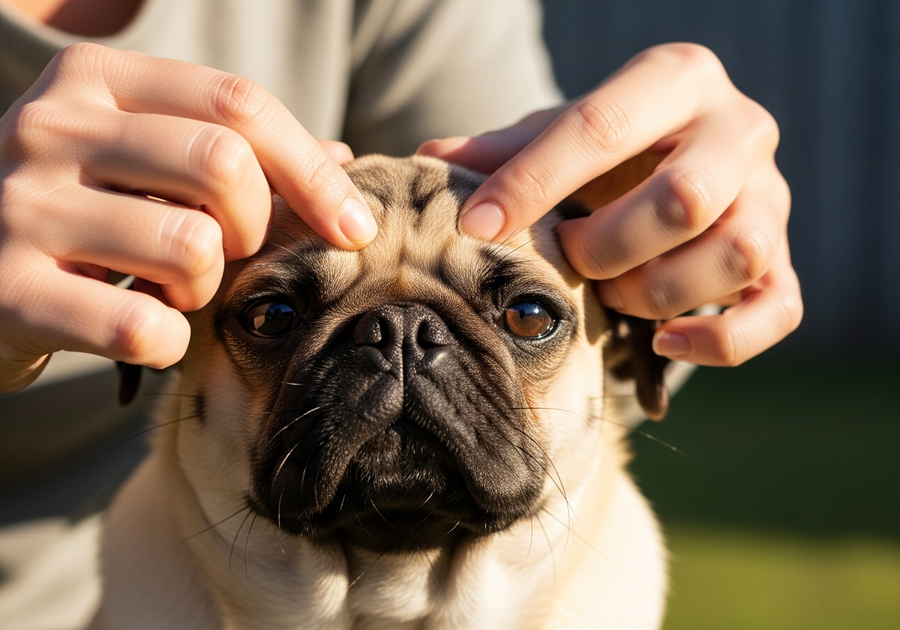
A February 2025 Australian study published in the journal Animals found a high prevalence of corneal disorders in Pugs attending primary care vet practices across Australia. This aligns with what Pug owners experience: those beautiful, prominent eyes are genuinely vulnerable. They protrude further from the skull than in most breeds, which means they're more exposed to trauma, dryness, and infection.
The most common eye conditions in Australian Pugs include:
- Corneal ulcers - superficial or deep wounds on the surface of the eye, often from dust, grass seeds, or accidental scratches during play. Signs include squinting, pawing at the eye, and clear or coloured discharge.
- Dry eye (keratoconjunctivitis sicca) - the tear glands don't produce enough moisture, leading to sticky discharge, redness, and in chronic cases, scarring of the cornea.
- Entropion - the lower eyelid rolls inward, causing the lashes to rub against the eye surface constantly. This is painful and needs surgical correction.
- Proptosis - in severe trauma, the eye can partially or fully dislodge from the socket. This is a veterinary emergency requiring immediate care.
Check your Pug's eyes daily. Any redness, cloudiness, discharge, or change in how often they blink warrants a same-day vet call. Eye conditions in Pugs deteriorate quickly. A corneal ulcer that's caught early can often be treated with drops; one that's left for a few days may require surgery or result in permanent vision loss. You can also learn more about their overall health trajectory in our guide to Pug lifespan and what affects it.
Skin Fold Dermatitis
Those deep facial wrinkles and the fold above the nose are a signature Pug feature. They're also a constant management task. Skin folds trap moisture, dead skin cells, and bacteria, creating warm, dark pockets where infections develop quickly. The problem isn't the folds themselves but what accumulates inside them when they're not cleaned regularly.
Skin fold dermatitis starts with redness and a sour smell, progresses to a brown or rust-coloured discharge, and can advance to painful, open infections that require antibiotic treatment. Beyond the face, Pugs also develop fold-related skin problems around the tail (the characteristic screw tail creates a skin pocket at the base) and sometimes under the belly.
Daily cleaning is prevention. Use a cotton ball dampened with a pet-safe cleanser or a gentle baby wipe to wipe inside each fold, then dry thoroughly. Moisture left inside a fold is what triggers infection. Some Pugs with particularly deep folds benefit from a light dusting of cornflour-based powder (not talc) to keep folds dry between cleanings.
Skin infections in Pugs can also be a sign of underlying allergies. If your dog's skin flares frequently despite good hygiene, a conversation with your vet about food or environmental triggers is worthwhile. Our detailed guide to Pug skin problems and solutions covers this in depth.
Hip Dysplasia and Joint Problems
Pugs are smaller than the large breeds most commonly associated with hip dysplasia, but they're not immune. The breed's compact, rounded body shape and tendency to carry excess weight puts unusual stress on the joints, particularly the hips and knees. Legg-Calve-Perthes disease (where the femoral head loses blood supply and begins to degrade) is also seen in the breed.
Signs of joint problems in Pugs include a reluctance to climb stairs, hesitation before jumping, a bunny-hopping gait when running, or stiffness after rest. Because Pugs are stoic and tend to adapt their movement rather than visibly complain, joint issues can go unnoticed until they're quite advanced.
Weight control is the single most effective intervention for joint health in Pugs. Every extra kilogram puts additional load on joints that are already under strain from the breed's structure. Low-impact exercise like short, frequent walks on soft surfaces keeps muscle mass without overloading the joints. Swimming is excellent for Pugs who tolerate it.
Daily joint support can also help, particularly as Pugs age. Look for supplements that support cartilage structure and joint mobility. Supporting dog joint health proactively is easier than managing pain reactively. For breed-specific recommendations, a vet experienced with brachycephalic dogs can assess your Pug's gait and advise on the right support approach for their age and weight.
Pug Dog Encephalitis (PDE)
PDE is a condition unique to Pugs. It causes inflammation and progressive destruction of brain tissue, and it's almost always fatal. The cause is still not fully understood, though genetic factors are believed to play a role. It typically affects young to middle-aged Pugs, most often females under five years old, though it can occur at any age.
Symptoms include seizures (often the first sign), disorientation, circling, sudden blindness, and loss of coordination. The progression can be rapid. There is no cure, but anti-inflammatory medications and anti-seizure drugs can sometimes slow the progression and manage symptoms, improving quality of life for a time.
If your Pug has a seizure, treat it as a veterinary emergency. Not all seizures in Pugs indicate PDE (other causes exist, including epilepsy and toxin exposure), but given the breed's specific risk, prompt investigation is essential. A neurological examination and MRI are needed for a confirmed diagnosis.
PDE is one of the reasons that pet insurance for Pugs makes particular financial sense. A neurological investigation, including MRI, can cost several thousand dollars in Australia. Knowing your Pug is covered means you can make decisions based on their health rather than cost. Understanding the full picture of Pug wellbeing is important for long-term planning. The Beagle faces some similar snout-related respiratory considerations, and our Beagle health guide is a useful comparison for owners who want to understand how airway anatomy varies across breeds.
Obesity and Weight-Related Health Risks
Pugs love food. They're motivated by treats in a way that makes training wonderfully easy but weight management genuinely hard. The problem is that excess weight in a Pug isn't just a cosmetic concern: it directly worsens every other condition on this list. It narrows the airways further in BOAS, increases stress on already-compromised joints, strains the heart, and makes temperature regulation (already difficult for the breed) even harder.
A healthy Pug should have a visible waist when viewed from above, and you should be able to feel (but not see) the ribs with light pressure. If the ribs are difficult to locate under a thick fat layer, your dog is overweight. Your vet can use a body condition score to give you an objective assessment.
Feeding measured portions (not free-choice) and choosing a complete, balanced food appropriate for the dog's age and activity level is the starting point. Treats should make up no more than 10% of daily calorie intake. Low-calorie treats like carrot slices or plain cucumber work well for Pugs who respond well to food rewards. Gut health also plays a role here: a well-functioning digestive system supports healthy weight and nutrient absorption. Supporting your Pug's gut health daily is a practical part of weight management.
Daily Management: What Pug Owners Do Differently
Owning a Pug well requires more daily management than most breeds. That's not a reason to avoid the breed, but it is something to build into your routine. The Pug owners who report the fewest health crises tend to share a few habits.
They keep their dogs lean. They exercise in the cool of the morning or evening, never in the midday heat, and they carry water. They clean facial folds and the tail fold daily. They check eyes every morning and act quickly on any changes. They use harnesses, not collars. And they budget for regular vet visits, knowing that early detection changes outcomes for this breed more than almost any other. Many of the same challenges apply to other small-but-sturdy breeds. If you're also researching the Dachshund, which shares the tendency to spinal and joint issues, our Dachshund health guide covers that breed's specific vulnerabilities.
A daily supplement routine can also support the areas where Pugs are most vulnerable. Gut health support, joint mobility support, and digestive enzyme coverage are all relevant for this breed's specific challenges. Looking at the best dog supplements available in Australia can help you understand what's worth considering for your Pug's individual profile.
When to Call Your Vet
Some signs in Pugs are always worth a same-day call. Take a Pug to the vet immediately if you see:
- Blue or purple tint to the gums or tongue (oxygen deprivation)
- Collapse or fainting, even briefly
- A seizure or sudden loss of coordination
- Any change to the eye, including cloudiness, squinting, or visible injury
- Vomiting combined with distress (Pugs are prone to gut issues)
- Unusual lethargy that doesn't resolve within a few hours
For concerns that aren't urgent, a six-monthly vet check is more appropriate for Pugs than the standard annual visit most breeds follow. The breed's health can change faster than the annual cycle catches. Your vet can track breathing assessments, weight, eye health, and skin condition over time, which gives a much clearer picture than a single annual snapshot.
Every Pug is different in how these conditions manifest and at what age. Some Pugs have very mild BOAS and live comfortably without intervention; others need surgery in the first two years. Some develop PDE; many don't. What's consistent is that staying close to your dog's normal makes it much easier to spot the moment something shifts. Take the Hero Health Assessment to get a personalised supplement plan based on your Pug's age, weight, and specific health profile.