

When your vet prescribes antibiotics, you probably feel relieved. The infection is being treated. But there's a side effect that catches many Australian dog owners off guard: a few days later, your dog's gut has turned to chaos. Loose stools, rumbling, sometimes full-blown diarrhea. The antibiotics are working on the infection but they're also taking out a big chunk of the beneficial bacteria that keep your dog's digestive system stable.
This is where Saccharomyces boulardii comes in. Unlike every other probiotic you'll find on a pet store shelf, this one is a yeast, not a bacterium. And that single difference is why it can do something no bacterial probiotic can: survive concurrent antibiotic treatment and keep your dog's gut supported while everything else is being disrupted.
What Is Saccharomyces Boulardii?
Saccharomyces boulardii is a tropical yeast probiotic with an unusual origin story. In the 1920s, French scientist Henri Boulard was travelling through Southeast Asia when he noticed locals chewing on the skin of lychee and mangosteen fruit to manage cholera-like symptoms. He isolated the responsible yeast and began studying it.
Today, S. boulardii is one of the most extensively researched probiotics in existence. It's studied across human gastroenterology, and over the past decade, veterinary researchers have been paying close attention to what it can do for dogs. The results are interesting.
It belongs to the same species family as baker's yeast (Saccharomyces cerevisiae) but behaves very differently in the gut. It doesn't permanently colonise the digestive tract. Instead, it passes through, doing its work as it goes, and clears the system within a few days of stopping supplementation. For many dogs, that transit is exactly what's needed.
Why Yeast Probiotics Work Differently to Bacterial Ones
Most probiotics for dogs contain bacterial strains like Lactobacillus acidophilus or Bifidobacterium animalis. These are legitimate and well-studied, but they come with one significant limitation: antibiotics kill bacteria. All bacteria. The beneficial strains included.
Give a dog a bacterial probiotic while they're on antibiotics and you've largely wasted the product. The antibiotic medication strips it out along with everything else. This is the core problem that S. boulardii solves.
Because S. boulardii is a yeast, antibiotics don't affect it. The mechanisms that antibiotics use to disrupt bacterial cell walls and reproduction simply don't apply to fungal organisms. S. boulardii can be given at the same time as antibiotics and continue functioning throughout the treatment course.
What the Research Shows
The evidence base for S. boulardii in dogs is still growing, but what exists is promising. A double-blind, placebo-controlled clinical trial published in 2018 tested S. boulardii in dogs with chronic enteropathies. Researchers found that dogs receiving S. boulardii showed measurable improvements in clinical scores, suggesting a meaningful effect on gut inflammation and function.
A 2022 study published in Veterinary Sciences examined the effects of S. boulardii supplementation on nutritional status, fecal parameters, microbiota and mycobiota in breeding adult American Staffordshire Terriers. The researchers found that supplementation positively influenced fecal consistency and the overall composition of the gut microbiome. Worth noting: this was in healthy dogs, suggesting a maintenance and preventive role, not just a reactive one.
A more recent 2025 study in the journal Veterinary Sciences continued this line of investigation, looking at how different formulations of S. cerevisiae var. boulardii affected fecal parameters in healthy adult dogs. The collective picture from these studies: S. boulardii supports gut function, influences the microbial environment, and appears well tolerated across breeds and life stages.
It's worth being honest about what "supports" means here. These studies show association and correlation. S. boulardii is not a treatment for gastrointestinal disease. If your dog has persistent diarrhea, bloody stools, or symptoms that last more than 48 hours, that's a vet conversation, not a supplement question. But for general gut support and antibiotic recovery, the evidence is solid enough to be meaningful.
When Does S. Boulardii Actually Help?
There are three situations where Australian dog owners most commonly reach for S. boulardii, and for good reason.
During and After Antibiotics
This is S. boulardii's most clear-cut use case. Antibiotic-associated diarrhea is common in dogs, typically showing up a few days into a treatment course. Starting S. boulardii at the same time as the antibiotics, and continuing for one to two weeks after finishing them, can help maintain gut stability through the course and support recovery afterward. For more on managing this period, our guide to probiotics for dogs after antibiotics covers the full timeline.
Acute Digestive Upsets
Garbage eating at the park. A sudden change in food. Table scraps from a well-meaning family member. Acute diarrhea from these triggers is one of the most common reasons dog owners visit the vet or start searching frantically at midnight. S. boulardii's mechanism, which involves binding to toxins, reducing gut inflammation, and reinforcing the intestinal barrier, makes it relevant here. For more on this topic, probiotics for dogs with diarrhea has more detail on what to look for and when to act.
Ongoing Gut Maintenance
Some dogs, particularly those with sensitive stomachs or a history of digestive issues, benefit from daily probiotic support as a baseline. Whether this is a dog that gets loose stools on long car trips, one that's had recurring gut problems, or simply a dog whose owners want to take gut health seriously from the start, a daily S. boulardii supplement can be a sensible long-term choice. If you're not sure whether your dog needs daily support, signs your dog needs a probiotic might help clarify things.

How S. Boulardii Supports the Gut
The mechanisms are actually quite specific. S. boulardii doesn't just flood the gut with microbes the way some bacterial probiotics do. It works through several distinct pathways that make it useful beyond simple microbiome restoration.
It produces protease enzymes that break down toxins produced by harmful bacteria, including those from Clostridium difficile, a common cause of antibiotic-associated colitis in humans and occasionally implicated in dogs. It reinforces tight junctions in the intestinal wall, which reduces the gut permeability that allows pathogens and inflammatory triggers to cross into the bloodstream. And it modulates the immune response in the gut lining, helping reduce local inflammation without suppressing systemic immune function.
For a complete overview of how dog probiotics work and what the different types do, that guide covers the full range of options.
Is S. Boulardii Safe for Dogs?
The safety record is strong. The 2018 double-blind trial specifically monitored for adverse effects in both healthy dogs and those with chronic enteropathies, and found none of clinical concern. The short transit time, where it doesn't permanently colonise the gut, also means the risk of imbalance from over-supplementation is low.
That said, there's one scenario to flag with your vet: dogs with severe immunosuppression or a confirmed fungal infection. Because S. boulardii is a yeast, there's a theoretical question about use in severely immunocompromised animals. In practice, this is rarely clinically relevant for otherwise healthy dogs receiving antibiotic treatment, but it's a conversation worth having if your dog has an underlying immune condition.
Dose-wise, products designed for dogs will specify the appropriate CFU level. The general target for dogs is around 10 billion CFU (10 billion colony-forming units) per serving. More is not necessarily better; the focus is consistency. Daily supplementation at a stable dose is more effective than sporadic high doses.
What to Look For in a S. Boulardii Supplement for Dogs
A few things to check before buying:
Species specificity: The label should name S. boulardii specifically, not just "probiotic yeast" or a generic yeast blend. Different yeast species have different properties, and the research is specific to S. boulardii.
CFU count: Look for at least 5 billion CFU per serve, with 10 billion being the target dose for meaningful gut support. Check that the CFU count is guaranteed at the time of use, not just at time of manufacture (CFUs can degrade in storage).
Complementary ingredients: S. boulardii works well alongside prebiotics (which feed beneficial gut bacteria) and digestive enzymes (which support nutrient breakdown). Green banana powder is another useful addition, providing resistant starch that acts as a prebiotic substrate.
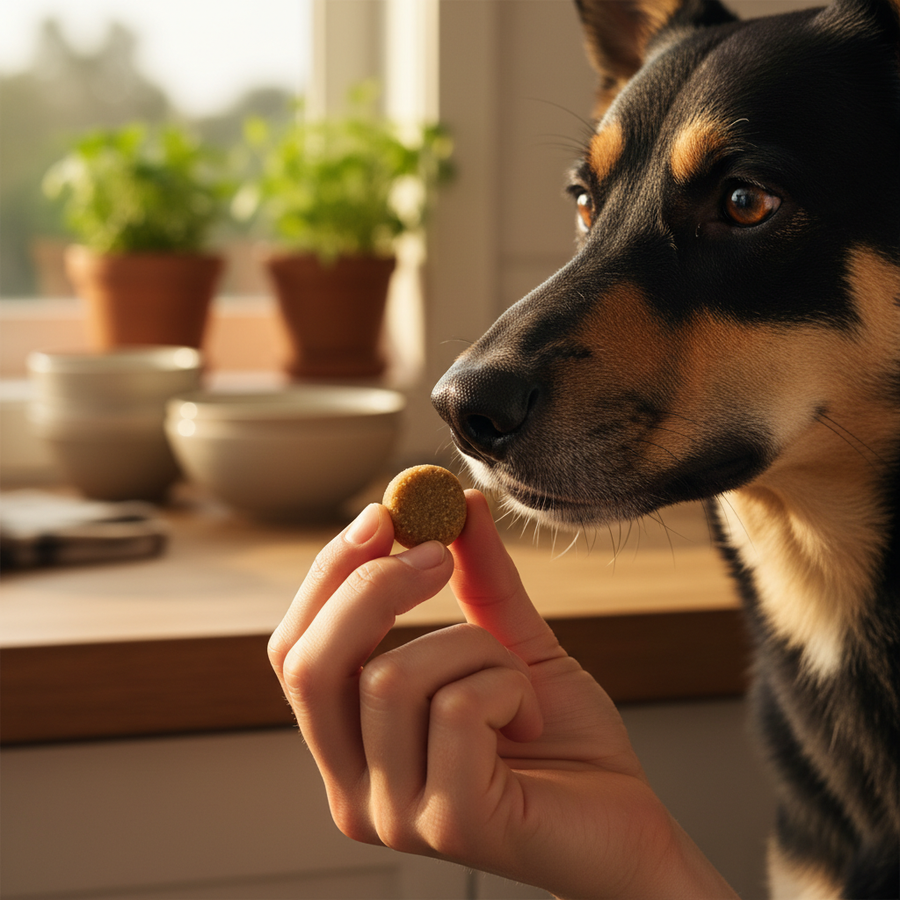
Format: Soft chews are the most practical delivery method for most dogs. They eliminate the mess of powder and the uncertainty of whether a capsule has been actually eaten.
Australian-made and vet-reviewed: Supplements manufactured in Australia are subject to local quality standards. A vet-reviewed formula adds another layer of confidence, particularly for a product you'll be using daily over months or years.
Hero's Probiotic Daily Chews contain 10 billion CFU of S. boulardii per chew, alongside prebiotics, digestive enzymes, bentonite, green banana powder, agave, and pectin. The formula is grain-free, wheat-free, and hypoallergenic, and the product is made in Australia and vet-reviewed. For more on how to choose between the many options available, the complete guide to the best dog probiotics in Australia covers what to look for across different categories.
Giving S. Boulardii to Your Dog: Practical Notes
Timing matters. If you're using S. boulardii during an antibiotic course, give the probiotic at a different time of day to the antibiotic, with at least a couple of hours gap. This isn't strictly necessary for S. boulardii the way it is for bacterial probiotics (since antibiotics don't kill it), but it's good practice when combining supplements with medication.
For general maintenance, one chew daily with food is the typical approach. For acute upsets or antibiotic recovery, some owners give the supplement for two to three weeks and then assess whether ongoing daily use makes sense for their dog.
Not every dog responds the same way. Most dogs with antibiotic-associated diarrhea see improvement within three to five days of starting S. boulardii. Dogs using it for general gut support may notice firmer stools and more consistent digestion over two to four weeks. If you're not seeing any improvement after four weeks of consistent daily use, that's worth discussing with your vet. Senior dogs and puppies have specific gut health needs that may require a more tailored approach.
A Note on the Gut Health Bigger Picture
S. boulardii is a tool, not a magic fix. It works best as part of a broader approach to your dog's gut health, which includes a quality diet, minimal unnecessary antibiotic use, and awareness of the early signs that something's off. The gut microbiome is complex, and no single supplement is going to override a fundamentally poor diet or repeated gut disruption.
That said, for the specific situation it was designed for, supporting dogs through antibiotics and helping the gut recover from acute disruption, S. boulardii has a genuinely useful and well-evidenced role. It's one of the few ingredients where the mechanism is clearly understood, the species-specificity matters, and the research in dogs (not just humans) is available to look at.
If your dog is about to start antibiotics, or you're managing a sensitive stomach, it's worth a conversation with your vet about whether S. boulardii supplementation makes sense. Most will be familiar with it. And if they're not, pointing them toward the 2022 Veterinary Sciences study is a good place to start the conversation.
For full details on dog gut health and how to build a long-term strategy, that resource covers diet, lifestyle, and supplementation in one place.

